Women Planting Mangroves: Coastal Shields Built by Hand

Why Mangroves Matter

Mangroves are salt-tolerant forests that grow where land meets sea. Their tangled roots slow waves, trap sediment and shelter fish and crabs. They also store carbon at high rates. India is reported to rank third globally in mangrove area, and areas sitting behind mangroves suffered less damage than exposed coasts when the 2004 tsunami struck.

Women Are Leading the Work

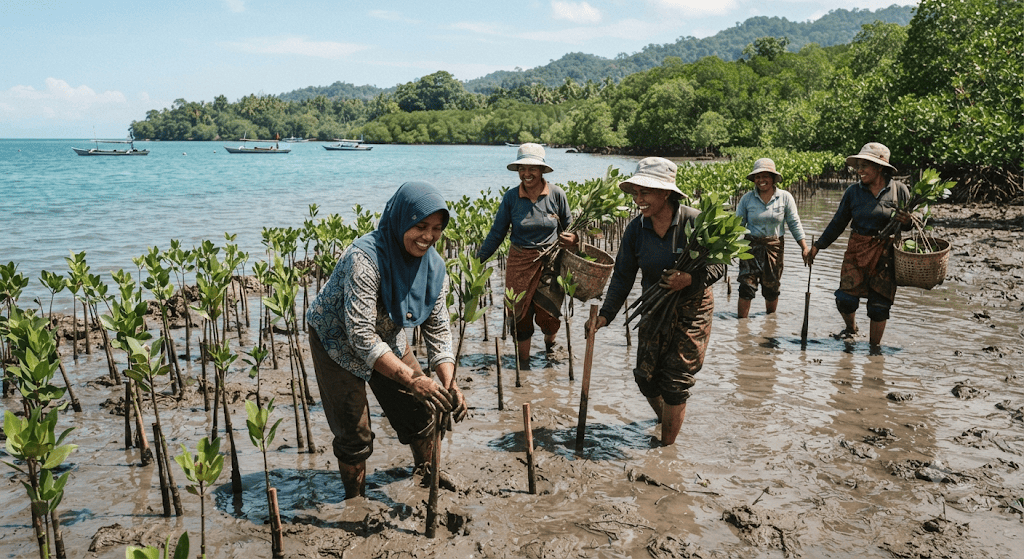
Across Andhra Pradesh, Odisha, Tamil Nadu, Maharashtra, West Bengal and Karnataka, women are managing mangrove nurseries, planting saplings and guarding forests. With many men away fishing for long periods, women have taken on the daily labour of restoration.

Stories From the Coast

Sundarbans, West Bengal. Women’s self-help groups raise saplings in nurseries and plant them along embankments. One NGO reports that 17 women’s groups there run mangrove nurseries, using an approach that links restoration to local income. The Sundarbans work later fed into a national mangrove plantation programme called MISHTI.

Puri, Odisha. Fisherwomen in Sana Jhadling tend mangrove saplings, motivated partly by memories of the devastating 1999 super cyclone.

Palghar, Maharashtra. A self-help group called Healthy Harvest restored degraded mangroves and also learned crab farming, earning about ₹85,000 a year collectively.

The Hard Part

Planting is hard, muddy work, often done knee-deep in clay. Restoration programmes are sometimes seasonal or short-lived, and weak enforcement and fragmented governance can undermine long-term success. Planting alone isn’t enough; trees need protection and follow-up for years.

How Travellers Can Help

  1. Choose guided mangrove walks or boat trips run by local cooperatives
  2. Stay quiet and keep boats at slow speed near nesting areas
  3. Never pick propagules or break roots
  4. Pay for local guides and buy from women-run stalls

Bottom Line

Mangrove restoration is slow, wet and unglamorous. The women doing it aren’t waiting for a rescue plan. They are building the coastline’s best defence themselves, one sapling at a time.
The Women Divers Reviving India’s Coral Reefs

Why India’s Reefs Need Help


India’s coral reefs are concentrated in four regions: the Gulf of Mannar, the Gulf of Kutch, the Andaman and Nicobar Islands, and the atolls of Lakshadweep. In the Gulf of Mannar, decades of coral mining and, more recently, repeated bleaching events have pushed reef cover into decline. Scientists attribute the damage largely to warming seas rather than tourism alone, but every additional stress — including careless diving — narrows the reef’s margin to recover.


A Homemaker Who Learned to Dive at 49


One of the more striking stories from this space is that of a Chennai-based homemaker who learned scuba diving in her late forties. Her underwater paintings and diving work around the Gulf of Mannar’s coral reefs eventually grew into an awareness movement, using art to draw attention to coral bleaching and inspire youth ambassadors for reef conservation.


The Unglamorous Restoration Work


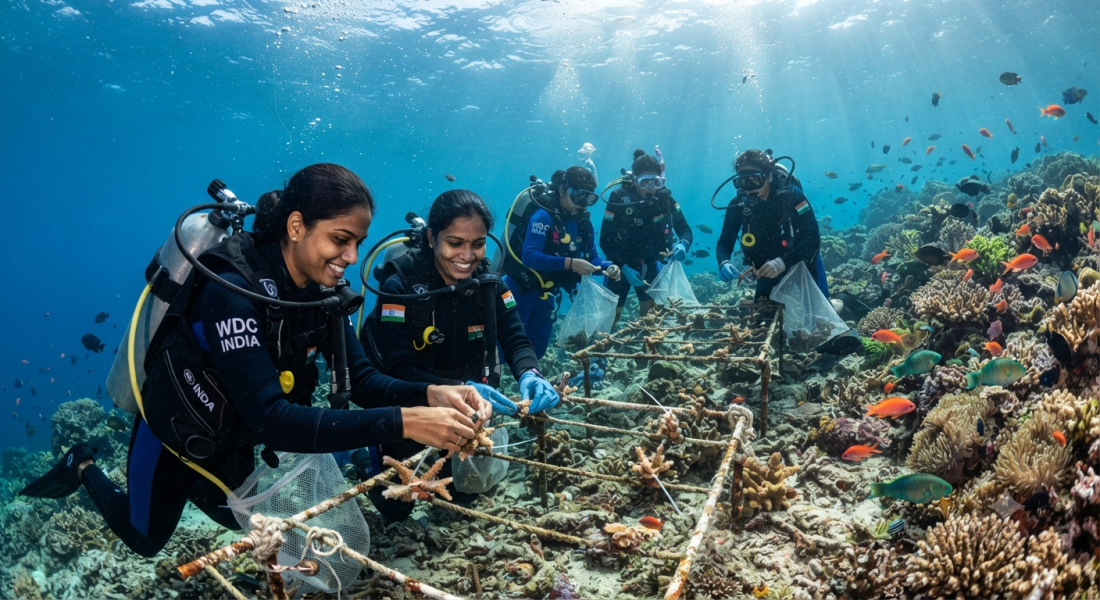
Reviving a reef isn’t a single dramatic act — it’s slow, repetitive underwater labour: clearing marine debris like abandoned fishing nets and ropes that smother live coral, transplanting coral fragments onto artificial structures, and monitoring recovery over months and years. Reef surveys around the Gulf of Mannar have found debris affecting a meaningful stretch of reef area, much of it fishing gear that has to be carefully removed by trained divers without damaging the coral beneath it.

Why This Work Suits — and Needs — More Women


Marine conservation and diving have historically skewed male, but reef restoration rewards patience, precision and steady hands over brute strength — qualities that make it a natural fit for more women to enter the field. Programs training women divers elsewhere in Asia have shown that all-female teams can run entire restoration operations, from underwater fieldwork to community outreach.

How to Support This Work as a Traveller


1. Dive only with operators who follow no-touch, no-collection rules.

2. Choose trips that include a marine conservation briefing.

3. Support NGOs and community groups doing reef debris cleanups.

4. Avoid buying coral or shell souvenirs.


Bottom Line


The women reviving India’s reefs aren’t chasing headlines — they’re doing the patient, underwater work of undoing decades of damage, fragment by fragment. The least the rest of us can do is dive, and travel, in a way that doesn’t undo their work.