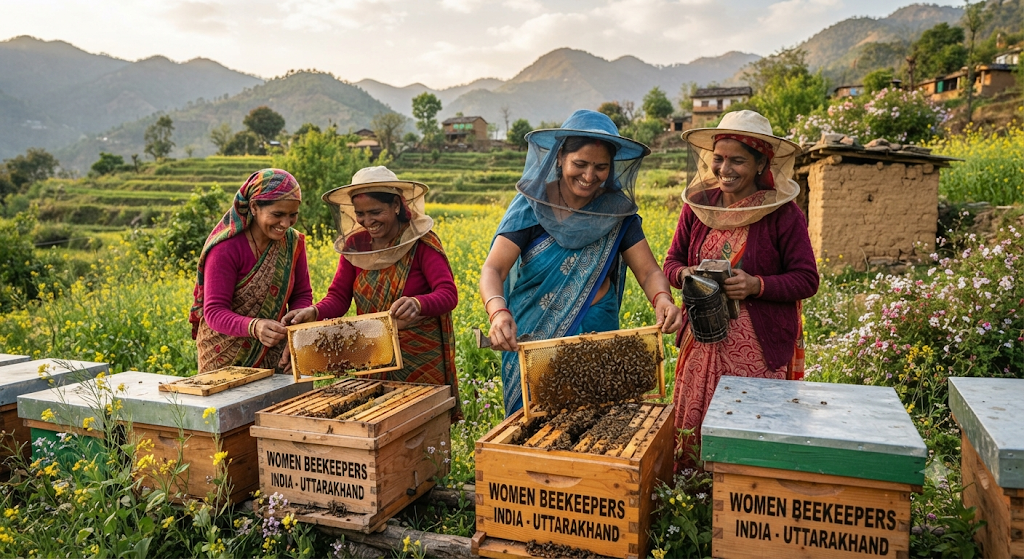
Women Beekeepers of India: Sweetening Livelihoods Sustainably

A Livelihood That Fits Around Everything Else

Beekeeping has an underrated advantage for rural women: it doesn’t compete with existing responsibilities the way a full-time job might. Hives can be tended in the early morning or evening, fitting around farm work and household duties, which is part of why self-help groups across states like Maharashtra, Uttarakhand, and Bihar have adopted it as a collective income source.

The Nilgiris Model

In the Nilgiri Biosphere Reserve, a beekeeping initiative trained Indigenous women from communities that had traditionally practiced wild honey hunting — a skill that’s both risky and increasingly restricted under forest protection laws. Managed beekeeping using hive boxes gave the same women a safer, more predictable version of a craft they already understood, using native bee species suited to the local ecosystem.

From Bihar’s Farmlands to Family Income

In Muzaffarpur district, Bihar, a group of women from below-poverty-line families who previously worked as temporary farm hands started an all-women beekeeping enterprise to build a steadier income stream. Their story reflects a broader pattern — beekeeping enterprises frequently start with a handful of women pooling resources and scale through shared training and equipment.

More Than Honey

Beyond income, the ecological ripple effect is real: more managed hives mean better pollination, which supports crop yields and biodiversity in the surrounding area. Several beekeeping programs pair training with tree-planting to strengthen the nectar and pollen sources hives depend on — a rare case where the economic and environmental incentives point the same direction.

Bottom Line

Beekeeping isn’t a novelty project in rural India anymore — it’s a functioning income model that’s letting women earn on their own terms while quietly supporting the ecosystems around them.
The Rise of Eco-Friendly Period Products in Indian Villages

A Problem Hiding in Plain Sight

Disposable sanitary pads don’t biodegrade for decades, and in villages without formal waste management, they’re routinely burned or buried near homes. For years, the environmental cost of periods was rarely discussed alongside the more visible issue of period poverty — but the two problems share a solution.

Cloth Pads Are Having a Comeback

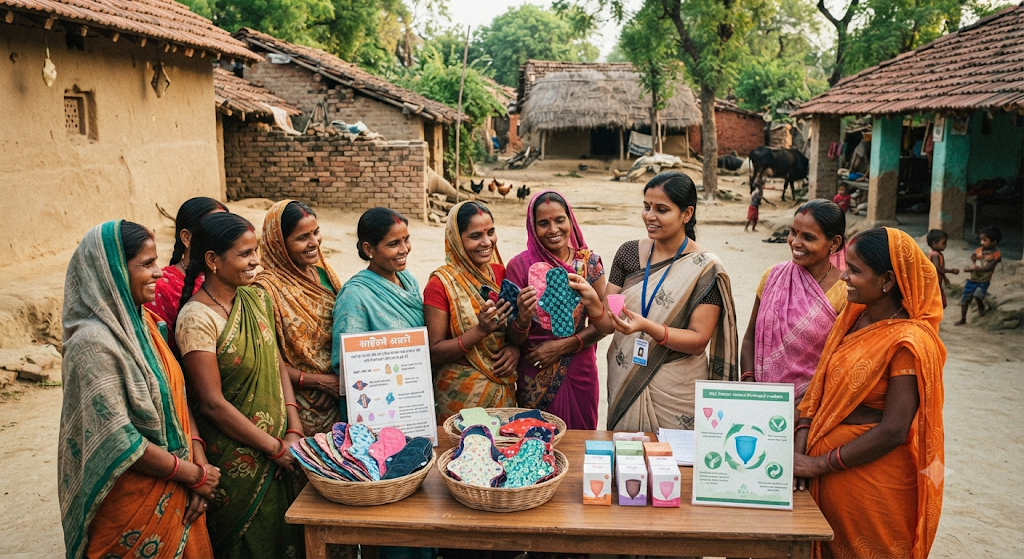
Reusable cloth pads, once dismissed as outdated, are being redesigned by women-led self-help groups and social enterprises with better absorbency, washable liners, and dignity-focused packaging. Several rural manufacturing units now train local women to stitch and sell these pads within their own communities, creating both income and access in one move.

Menstrual Cups Enter the Conversation

Menstrual cups are a newer addition to rural health workshops, though adoption is slower — it requires comfort with the body that many first-time users need guided support to build. NGOs running these workshops often pair the product demo with basic menstrual health education, since the two barriers (cost and stigma) rarely get addressed separately.

Why the Environmental Angle Matters Here

Framing reusable products purely as “eco-friendly” can miss the point in a village context — the bigger win is often affordability and reduced dependence on shops that may not stock pads reliably. The environmental benefit is real, but it works best as a bonus argument, not the opening one.

Bottom Line

The eco-friendly period movement in rural India isn’t a trend borrowed from urban sustainability circles — it’s a practical answer to cost, access, and waste, built by women for women.

How Indian Villages Are Leading Grassroots Water Conservation

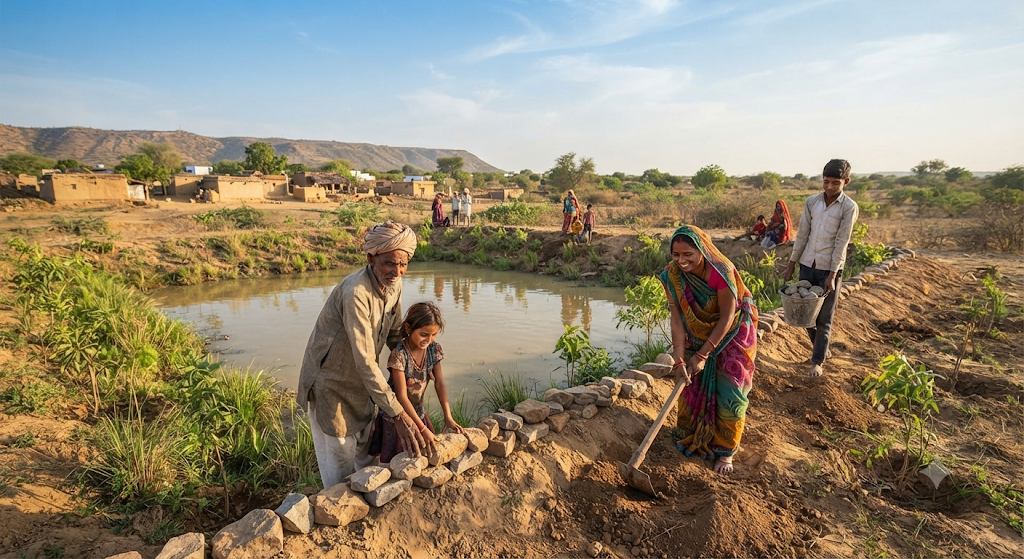
Large dams and canal projects tend to dominate the conversation around water security in India. But some of the most effective, lasting solutions are happening at a much smaller scale — in villages where residents themselves are rebuilding ponds, digging trenches, and reviving traditions that outdate any modern engineering project.

Sukhomajri, Haryana: Where It Started

In the 1970s, the village of Sukhomajri in Haryana faced a familiar crisis — torrential runoff stripping the soil, a silted-up lake, and dry wells. Villagers, working with scientists from the Indian Council of Agricultural Research and the Haryana Forest Department, fenced off slopes from grazing, dug contour trenches, and built small earthen dams to capture rainwater for gravity-fed irrigation. It became one of the earliest and most-cited models of community-led watershed management in the country.

Kothapally, Telangana: Measurable Results

In Kothapally, farmers combined simple methods like contour bunds with better seeds and intercropping. Within five years, groundwater levels rose by up to 45%, and maize yields quadrupled — numbers substantial enough that families began diversifying into chickpeas and vegetables once water and income were secured.

The Arvari Sansad, Rajasthan: A River Parliament

Along the Arvari River, 70 villages formed the Arvari Sansad, or River Parliament — a community governance body that manages water use, prevents over-extraction, and resolves disputes without waiting on government intervention. It’s a striking example of communities becoming the direct guardians of a shared water resource, rather than relying on external authorities.

Jakhni, Uttar Pradesh: A Model That Spread

In the drought-affected Bundelkhand region, Jakhni village became known for building bunds, desilting wells, and constructing new ponds. Its success was significant enough that district officials later used it as a template, redirecting available funds to replicate the same model across the wider region.

Tamil Nadu’s Kudimaramathu: Reviving Ancient Systems

Rather than build something new, the Kudimaramathu scheme in Tamil Nadu revived centuries-old irrigation tanks through public participation. Farmers, engineers, and local youth worked together to desilt tanks, repair sluices, and clear catchments — rejuvenating thousands of hectares of farmland across drought-hit districts.

Why Grassroots Models Work

These efforts share a common thread: they’re decentralized. Instead of concentrating water storage and distribution in a single large point, community-led catchment management spreads it across many small, locally-managed structures — ponds, bunds, and trenches that villagers themselves maintain and have a direct stake in protecting.

Bottom Line

Water conservation in India isn’t only a policy conversation happening in government offices. In villages across Haryana, Telangana, Rajasthan, Uttar Pradesh, and Tamil Nadu, it’s already being lived out — often led by the same communities who stand to lose the most if it fails.