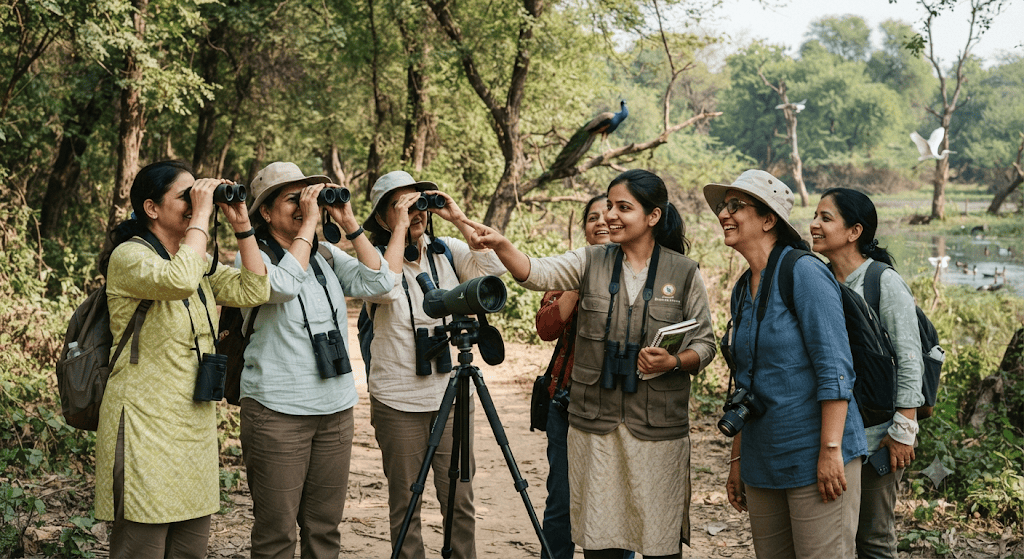
The Rise of Women-Led Bird watching Tours in India

A Field That’s Been Mostly Male

Wildlife guiding in India has historically skewed heavily male, and birdwatching has been no exception, even though India is one of the world’s most visited destinations for it. That’s beginning to shift — slowly, through training programs and community initiatives that are putting binoculars in the hands of women who’d never held one before.

From First-Time Birders to Leading Tours

In Tadoba, a workshop introduced a group of women — many holding binoculars for the first time — to birdwatching as a guiding skill. Within months, the same women were leading birding teams during an annual bird race and actively contributing to citizen science challenges through platforms like eBird. What started as training became a new professional identity.

A Growing, Visible Community

Bird Count India’s ongoing “Women in Birding” profile series has featured women birders from cities, villages, coastal regions, mountains, forests and islands across the country — naturalists, researchers, hobbyists and citizen scientists, each with a different route into the field. Annual events like Big Bird Day have also become spaces where women birders explicitly build community and swap field notes, not just species counts.

Why This Matters for Travel

A women-led or women-friendly birding tour often changes more than who’s holding the binoculars — it can mean different pacing, different safety considerations and local knowledge shaped by a different relationship to the landscape. For women travellers specifically, it can also mean a more comfortable group dynamic for early-morning or remote outings.

How to Find and Support These Tours

  1. Look for women naturalists and guides at wildlife reserves and sanctuaries
  2. Follow regional birding clubs — many now have women coordinators
  3. Join citizen science birding events, which often include guided women-led walks
  4. Ask tour operators directly whether they employ women naturalists

Bottom Line

Birdwatching rewards patience over physical strength, which may be exactly why more women are finding their place in it — first as hobbyists, then increasingly as the ones leading others into the field.
Women in Wildlife Photography: Patience, Risk, and the Perfect Frame

Wildlife photography has long carried an image of rugged, solitary men crouched in the bush for hours. That image is steadily being challenged by a growing number of women building genuine, respected careers in a field that demands patience, physical endurance, and a real tolerance for risk.

The Unglamorous Reality of the Work

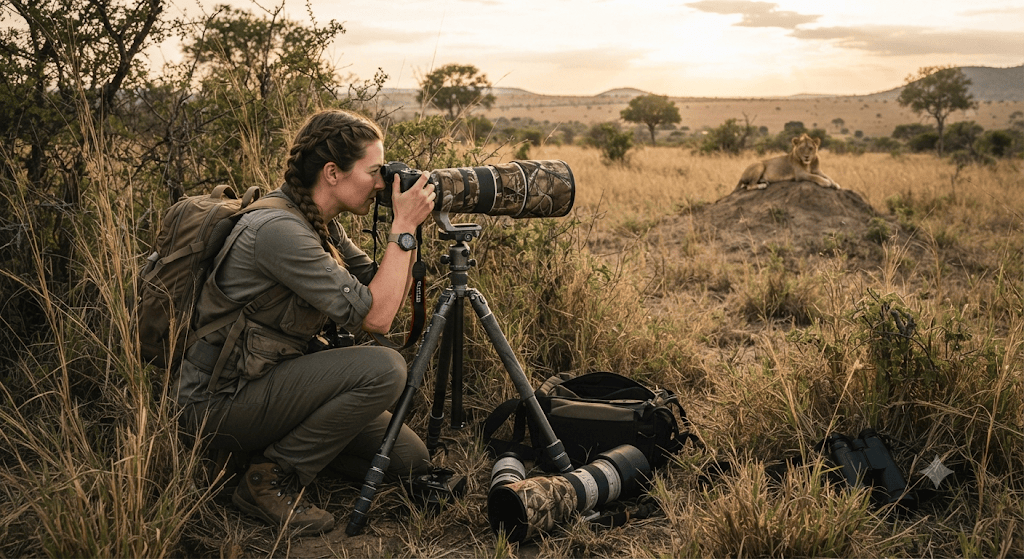
Wildlife photography involves far more waiting than shooting — hours or even days positioned near a waterhole or den site, in extreme heat or cold, often with no guarantee that the anticipated shot will ever materialize. The romantic image of the “perfect frame” hides an enormous amount of unglamorous, physically demanding patience.

Facing Skepticism in the Field

Women wildlife photographers have often described being underestimated by local guides, forest staff, or even fellow photographers early in their careers — an assumption that physically demanding fieldwork wasn’t a natural fit for them, an attitude that’s shifted considerably but hasn’t disappeared entirely.

Building Technical Expertise From Scratch

Wildlife photography requires specific technical mastery — understanding animal behavior to predict movement, working with specialized long lenses, managing unpredictable lighting in the field — skills built over years of dedicated practice, same as any photographer regardless of gender, though often without as many visible mentors or role models to learn from directly.

The Physical and Safety Risks Involved

Working in proximity to wild animals, navigating remote terrain, and spending extended periods in isolated locations carries genuine physical risk — risk that doesn’t discriminate by gender, but that women in the field have sometimes had to actively push back against being told they shouldn’t take on.

Bringing a Different Perspective to the Work

Some women wildlife photographers have spoken about approaching their subjects with a particular sensitivity to behavior and storytelling — less focused purely on the dramatic “action shot,” and more interested in quieter, relationship-driven moments within animal groups, adding a distinct voice to a field often dominated by a narrower visual style.

Mentorship and Visibility Growing Slowly

As more women’s work gains recognition through awards, publications, and social media visibility, it’s gradually becoming easier for newer photographers to see a viable path into the field — role models that simply didn’t exist as visibly a generation ago.

Bottom Line

Wildlife photography rewards patience, technical skill, and a willingness to sit with real discomfort and risk for the sake of a single frame — qualities that have nothing to do with gender, but that women in the field have had to prove repeatedly regardless. Their growing presence is slowly reshaping who gets to be seen as an authority in this space.

The Women Documenting India’s Disappearing Traditions Through Photography

Many of India’s traditional crafts, rural rituals, and regional ways of life are fading faster than they’re being recorded — a generational shift that risks losing not just skills but the visual memory of how things were done. A growing number of women photographers are working specifically to document this before it disappears entirely.

Why This Documentation Matters

Oral traditions and hands-on crafts often exist only in the memory and practice of an aging generation, with little formal documentation. Photography captures not just the final product of a tradition — a woven textile, a ritual object — but the process, the hands, and the context that a museum piece alone can never fully convey.

Access Built on Trust, Not Just Skill

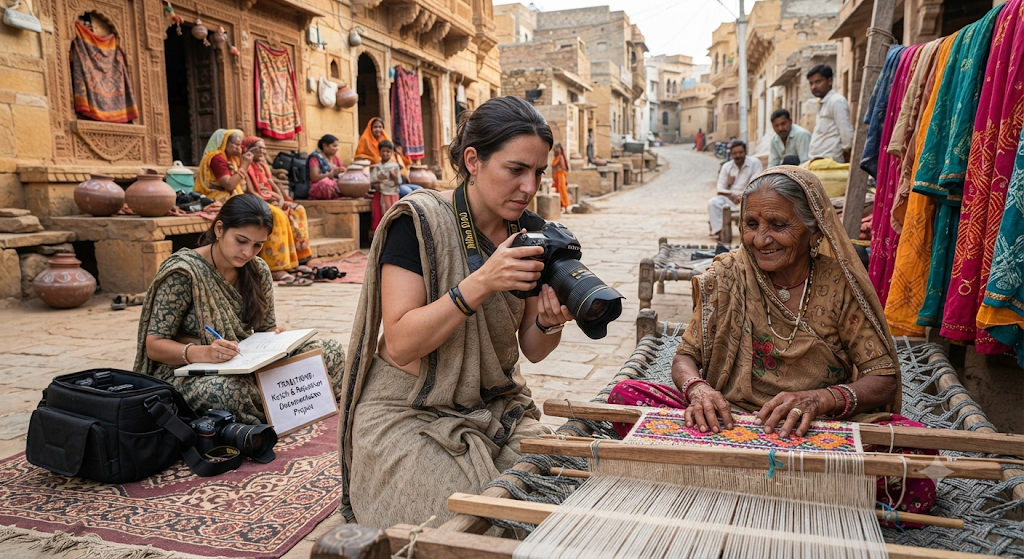
Photographing intimate community rituals, women-only ceremonies, or closed craft workshops often requires a level of trust that’s easier to build as a woman photographer, particularly in more conservative or gender-segregated community settings where a male photographer might simply never be given access.

Documenting Craft, Not Just Culture

Beyond rituals and ceremonies, many women photographers focus specifically on documenting disappearing craft techniques — a particular embroidery style, a pottery method, a weaving technique — often working closely alongside the artisans themselves, sometimes over years, rather than a single visit.

The Race Against Time

Many of these traditions are held by artisans and practitioners now in their 70s and 80s, with no younger generation continuing the practice. Photographers working in this space often describe their work with real urgency — knowing that a specific technique or ritual may simply not exist to document again in a few years’ time.

Beyond Just Preservation

This work isn’t purely archival — much of it also aims to bring visibility and, ideally, economic support back to the communities and artisans being documented, connecting traditional practices to broader audiences who might otherwise never encounter them.

The Emotional Weight of the Work

Photographers doing this work often describe it as deeply personal, not purely professional — building real relationships with the people and communities they document over repeated visits, rather than treating subjects as simply visual material to be captured and left behind.

Bottom Line

As India modernizes rapidly, a quiet but important body of documentation work is being done by women photographers determined to make sure these disappearing traditions aren’t lost without a visual record. It’s patient, relationship-driven work — and increasingly urgent.