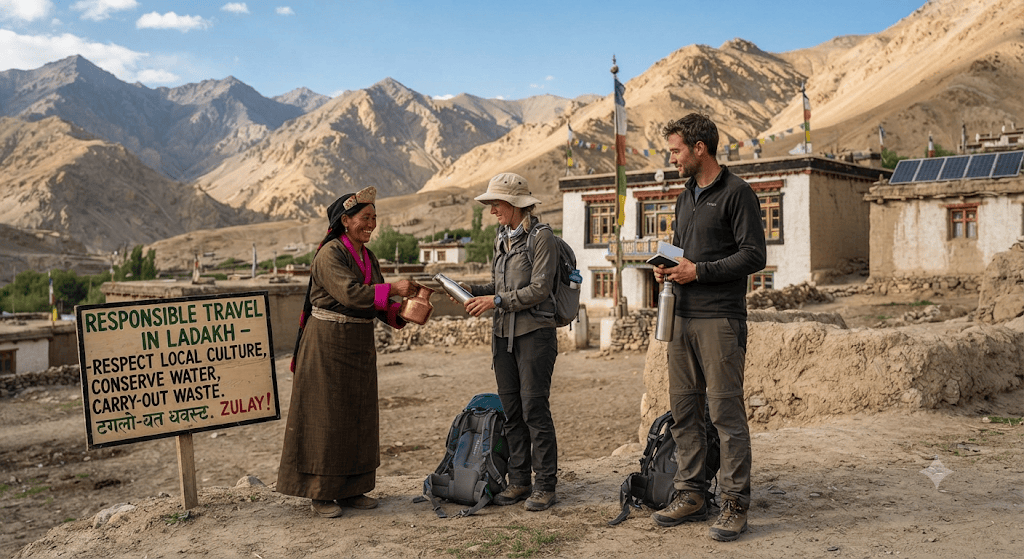
Responsible Travel in Ladakh: Water, Altitude and Local Culture

A Fragile Place With a Booming Visitor List

Ladakh sits in the Himalayan rain shadow and depends largely on glacier melt for water. Tourism has grown fast. One report notes that the 1980s saw only about two dozen hotels across Ladakh, while today there are several hundred, most of them in Leh. More bathrooms, more guesthouses and more visitors all draw on the same limited supply.

Water: The Biggest Issue

A study by the Ladakh Ecological Development Group found that an average Ladakhi uses about 21 litres of water a day, while a tourist may use as much as 75. Other estimates vary, but all point the same way: visitors use far more than residents.

What you can do:

  1. Take short, bucket-style baths instead of long showers
  2. Use local dry toilets where homestays offer them
  3. Carry a reusable bottle and refill it instead of buying plastic bottles
  4. Reuse leftover washing water for plants where you can

Altitude: Respect It

The Ladakh tourism department advises at least 48 hours of acclimatisation after arriving in Leh, plenty of fluids, light meals on day one, and avoiding sleeping pills or sedatives at altitude. Don’t rush to higher passes straight after landing, and descend if severe symptoms appear. If you plan to take altitude medication, speak to your doctor first.

Culture: You’re a Guest

Ladakh is home to a living Tibetan Buddhist culture. Ask before photographing people or monks, dress modestly at monasteries, walk clockwise around stupas and prayer wheels, and avoid touching religious objects.

Where You Stay Matters

Homestays keep money in local households and often use water more carefully than large hotels. They also give you home-cooked food and conversation that no hotel buffet can match.

Don’t Leave Plastic Behind

Plastic breaks down slowly at high altitude and can contaminate streams near popular spots. Carry your waste out with you.

Bottom Line

Ladakh doesn’t need fewer travellers so much as more thoughtful ones. Use less water, go slowly, stay local and leave the place as you found it.

How to Choose a Responsible Wildlife Safari Operator in India

Why the Operator You Choose Matters

Tiger reserves and sanctuaries run on strict carrying-capacity rules — limits on how many vehicles and tourists can enter at a time. The National Tiger Conservation Authority’s own 2012 guidelines require tourist vehicles to stay a minimum distance apart to avoid crowding animals, and cap how much of a reserve’s area can be used for tourism at all. A good operator works within these limits. A bad one pressures forest guides to bend them for a better photo.

Recent Rules Are Getting Stricter, Not Looser

In November 2025, the Supreme Court tightened controls further — pushing tiger safaris toward buffer and non-forest land and banning night tourism in core zones. That direction matters for travellers too: an operator who still promises unrestricted night drives or guaranteed close-up sightings in core areas is not one working within current rules.

Signs of a Responsible Operator

  • Follows official carrying-capacity and vehicle-distance rules without complaint
  • Employs and trains local guides and drivers
  • Limits group size and vehicle speed inside the park
  • Briefs guests on not baiting animals, playing loud sounds or leaving the vehicle
  • Supports, or is transparent about, conservation or anti-poaching contributions
  • Doesn’t promise a guaranteed sighting — no ethical operator can promise wild animal behaviour

Questions to Ask Before Booking

  1. How many vehicles does your group send in per slot?
  2. What happens if we don’t spot the animal — do you follow the vehicle to force a sighting?
  3. Are your naturalists trained and are guides from the local community?
  4. What’s your policy on maintaining distance from animals?

Red Flags

  • Ads promising “100% tiger sighting”
  • Vehicles clustering around one animal
  • No mention of forest department permits
  • Guides encouraging loud calls or off-road driving to chase wildlife

Bottom Line

A responsible safari operator protects the very thing you paid to see. Choosing one carefully means fewer crowded jeeps around a stressed animal — and a better, more honest wildlife experience for you.

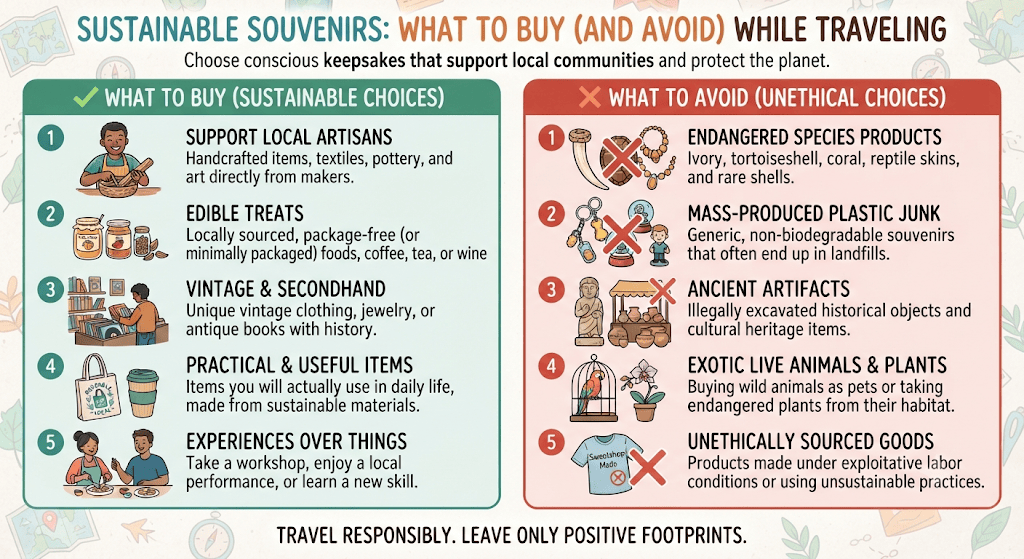
Sustainable Souvenirs: What to Buy (and Avoid) While Traveling

Souvenir shopping feels like a harmless, even supportive part of travel — but not every souvenir actually benefits the place it comes from, and some genuinely work against it. A little awareness turns souvenir shopping into something that actually gives back.

What to Look For

  • Handmade, locally produced items — textiles, pottery, woodwork — made by artisans in the region you’re visiting, rather than imported items simply sold there
  • Products from cooperatives or artisan collectives, which often ensure fairer pay reaches the actual makers rather than being absorbed by middlemen
  • Items made from sustainably sourced materials, particularly relevant for wood, shell, or plant-based products
  • Food items and spices sourced and packaged locally, which support regional agriculture directly

What to Avoid

  • Wildlife products — anything made from coral, ivory, animal skins, shells, or feathers, which often drives illegal poaching or environmental damage regardless of how it’s marketed
  • Mass-produced “local” items that are actually manufactured elsewhere and shipped in, offering no real benefit to the local economy despite the packaging
  • Ancient or archaeological artifacts, genuine or convincingly fake, which are frequently illegal to export and contribute to looting when authentic
  • Single-use or excessive packaging, which undercuts the sustainability of an otherwise reasonable purchase

Ask Before You Buy

A simple question to the seller — “who makes this, and where?” — often reveals a lot. Sellers proud of local, artisan-made goods are usually happy to share the story behind them; vague or evasive answers are often a signal the item isn’t what it’s marketed as.

Consider the Souvenir’s Actual Life After the Trip

A souvenir that ends up unused in a drawer within a year has the same environmental footprint as any other unnecessary purchase, regardless of how ethically it was sourced. Choosing something genuinely useful or meaningful — rather than buying for the sake of having bought something — reduces this kind of eventual waste.

Supporting the Economy Beyond Souvenirs

Buying meals, tours, and accommodations from local, small-scale businesses often has a bigger positive economic impact than souvenir shopping alone — souvenirs are one part of a broader pattern of how travel spending reaches (or bypasses) the local community.

Bottom Line

A souvenir can genuinely support a destination’s artisans and economy, or it can quietly contribute to exploitation, environmental harm, or a local economy that sees none of the benefit. A little curiosity about where an item actually comes from turns an ordinary purchase into a more meaningful one.

How to Choose Eco-Friendly Homestays While Booking Online

Booking platforms are full of listings tagged “eco-friendly” or “sustainable” — but the label alone doesn’t mean much without digging a little deeper. Here’s how to actually evaluate a homestay before booking, instead of taking the tag at face value.

Look Past the Tag, Into the Description

A genuinely sustainable homestay usually describes specific practices — solar power, rainwater harvesting, composting, local sourcing — rather than just the word “eco-friendly” sitting alone in the listing title. Vague labeling with no specifics is often a sign the tag is more marketing than practice.

Check for Local Ownership and Employment

Homestays run by local families, employing local staff, tend to have a smaller footprint and a more direct positive impact than larger properties built and staffed from outside the region. Listings that mention this directly are usually more transparent about their model.

Read Reviews for Specifics, Not Just Ratings

A high star rating alone doesn’t confirm sustainability. Reviews that mention things like “loved the solar-heated water” or “they compost all kitchen waste” are far more reliable indicators than a generic five-star rating with no detail.

Ask Before You Book

Most hosts are happy to answer direct questions about water sourcing, waste management, or energy use if asked. A quick message before booking — “how do you manage waste and water here?” — often reveals more than the listing itself.

Watch for Over-Construction

A homestay advertised as eco-friendly but built with heavy concrete construction, large manicured lawns, or excessive amenities is often working against the very label it’s using. Simpler, more traditional construction methods usually align better with genuine sustainability.

Prioritize Small Over Large

Smaller, family-run homestays generally have a lighter environmental footprint than larger resort-style “eco” properties, simply due to scale — fewer rooms, less infrastructure, less resource consumption per guest.

Bottom Line

“Eco-friendly” is an easy word to add to a listing and a harder one to actually practice. A little extra reading — and a direct question or two before booking — goes a long way toward finding a stay that’s genuinely living up to the label, not just wearing it.