If you’ve ever had to ask a stranger for a pad, skip school because you didn’t have access to menstrual products, or use a rag, sand, ash, or newspaper during your period — you already know what period poverty feels like. For millions of women and girls across India, this isn’t a hypothetical. It’s a monthly reality.
Period poverty isn’t just about not being able to afford a pack of sanitary pads. It’s a tangle of three things: lack of access to safe menstrual products, lack of access to clean water and private toilets to manage periods hygienically, and — maybe the most stubborn of all — the silence and shame that stops girls from asking for help in the first place.
The Scale of the Problem
Government surveys have repeatedly shown that a large share of menstruating women in India still don’t use hygienic methods of protection, especially in rural areas. The gap isn’t uniform either — it varies sharply by state, by income, and by whether a girl is still in school. Many girls drop out of school entirely once they start menstruating, not because they want to, but because their school has no functioning toilet, no privacy, and no way to manage a leak with dignity.
This isn’t a “women’s issue” tucked away in a corner. It affects education outcomes, workforce participation, and public health — which is exactly why it deserves more attention than it gets.
What’s Actually Being Done
The good news is that period poverty in India isn’t being ignored anymore. Here’s where real movement is happening:
1. GST removal on sanitary products. In 2018, after sustained public pressure and activism, India removed the 12% GST that had been levied on sanitary napkins. It was a small line item that made a real difference in affordability at scale.
2. Government distribution schemes. Programs at both the central and state level have worked to supply subsidized or free sanitary pads through schools and primary health centres, particularly targeting rural and adolescent girls. Coverage is uneven, but the intent — and the infrastructure — now exists in places it didn’t before.
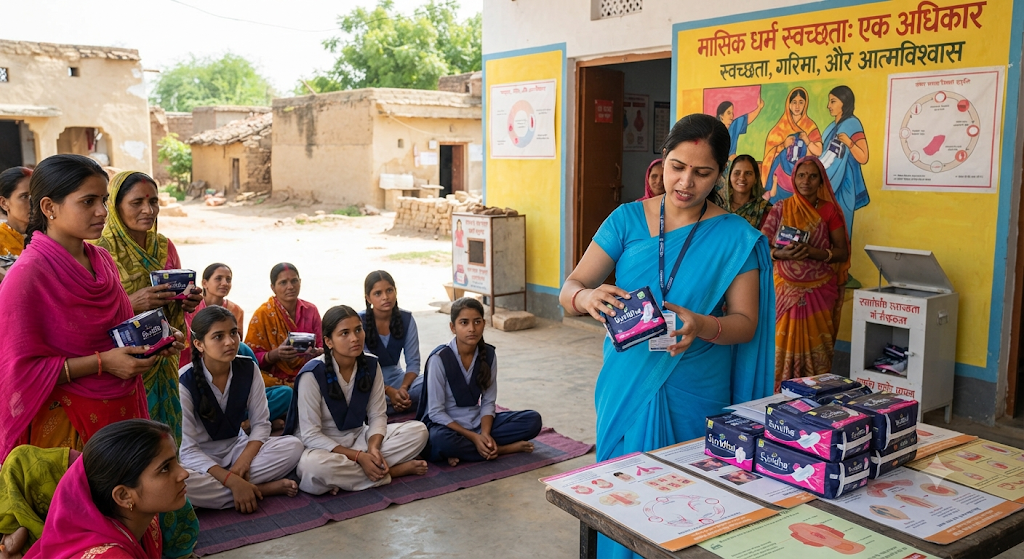
3. Menstrual health in the school curriculum. Several states have started integrating menstrual hygiene education into school health programs, training teachers and health workers to talk about periods without euphemism or embarrassment, and installing incinerators and sanitary vending machines in government schools.
4. NGOs closing the last-mile gap. Organizations working at the grassroots level — going village to village, training local women as menstrual health educators, manufacturing low-cost sanitary pads through community-run micro-enterprises — have often reached places that policy alone hasn’t. Some of the most effective models pair product distribution with education, because handing someone a pad without addressing the stigma around periods only solves half the problem.
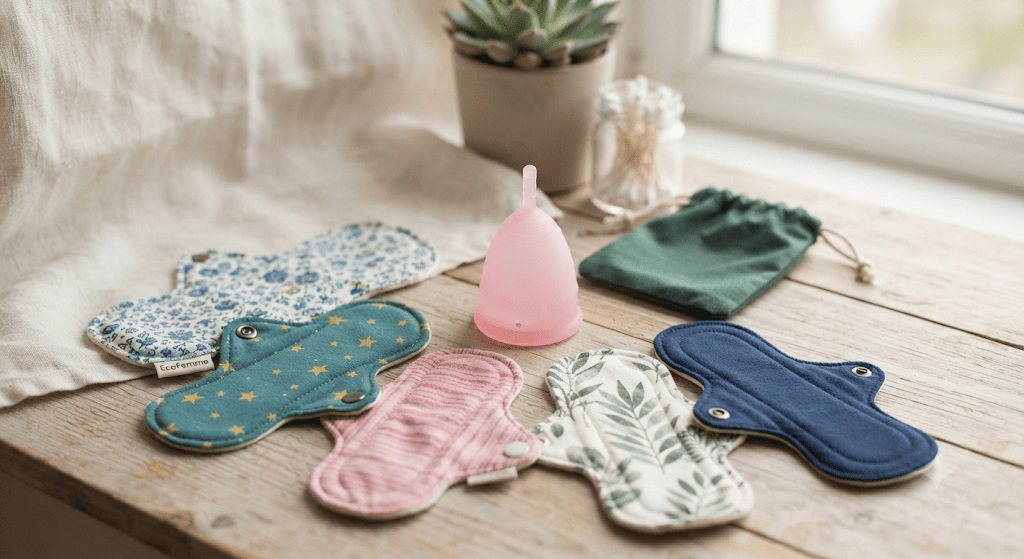
5. Sustainable and reusable alternatives. Menstrual cups, cloth pads, and period underwear are getting more visibility, both as a cost-saving option for low-income households and as a lower-waste alternative to disposable pads, which are a genuinely enormous environmental burden — most contain plastic and take centuries to break down.
Where the Gaps Still Are
For all this progress, period poverty hasn’t been solved — not close. Distribution schemes don’t always reach the most remote areas. Products supplied by some programs are inconsistent in quality. And the biggest gap of all is cultural: even where products are available, shame and silence still keep many girls from using them confidently, or from talking to a parent, teacher, or doctor when something feels wrong.
Access without education is a half-measure. A girl who has a pad but has never been told what a period actually is, why it happens, or that it’s nothing to be ashamed of, is still navigating this mostly alone.
What You Can Actually Do
You don’t need to run an NGO to make a dent in this. A few starting points:
- Support grassroots organizations directly working on menstrual health in your city or state — many are chronically under-resourced and rely on small, recurring donations more than one-time large ones.
- Normalize the conversation at home. If you have younger sisters, cousins, or nieces, be the person who talks about periods like it’s just biology — because it is.
- Donate products, not just money, during pad drives, especially before monsoon season and before the school year starts, when supply often runs low.
- Choose sustainable products where you can, and talk about them openly — cups and reusable pads are still seen as niche in a lot of households, and visibility helps.
Period poverty sits at the intersection of everything this blog cares about — women’s dignity, environmental impact, and access to basic health infrastructure. It’s a solvable problem. It just needs more people treating it like the public health issue it actually is, instead of a private embarrassment to whisper about.