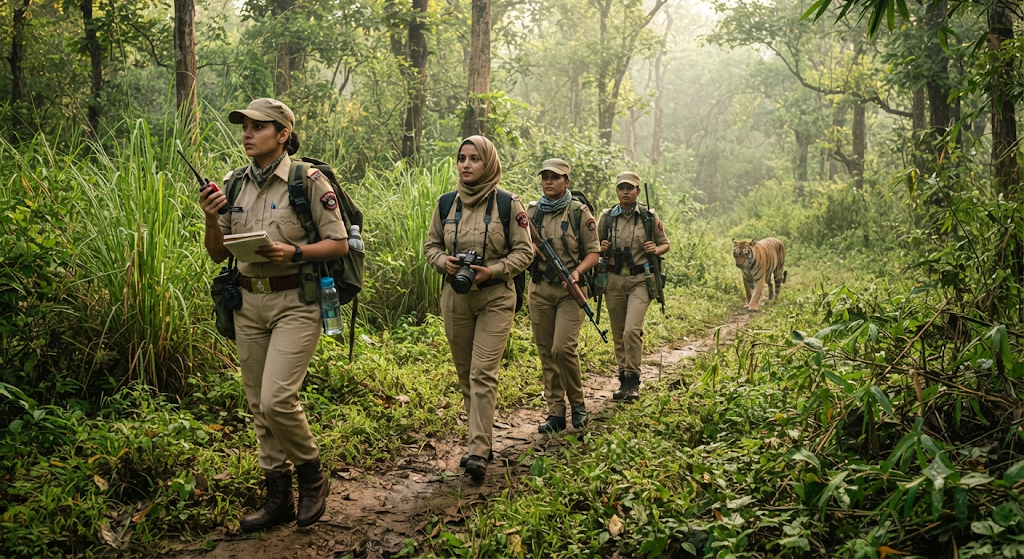
Forest protection has long been seen as a man’s domain in India — long patrols, physical risk, remote postings. But across the country’s reserves, thousands of women are now doing exactly this work, often in some of India’s most challenging terrain.
Gir National Park: The Lionesses of Gujarat
<cite index=”1-1″>Gujarat’s Gir Forest appointed its first batch of 51 women forest guards in 2007</cite>. These women patrol vast stretches of forest protecting the world’s only wild population of Asiatic lions, regularly handling wildlife rescues — from injured lion cubs to venomous snakes — as part of routine duty rather than exceptional heroics.
Kaziranga’s “Van Durgas,” Assam
<cite index=”3-1″>At Kaziranga National Park, female forest guards known locally as “Van Durgas” come from rural communities and work to protect wildlife and habitat across the park’s roughly 430 square kilometers</cite>. <cite index=”4-1″>The park now includes around 40 female rangers across roles like Range Officers, Forest Guards, and Foresters</cite>, alongside a dedicated women’s unit within the Special Rhino Protection Force guarding the endangered greater one-horned rhinoceros from poaching.
Dudhwa Tiger Reserve, Uttar Pradesh
<cite index=”6-1″>Dudhwa Tiger Reserve has recruited young men and women as forest watchers</cite>, with officials describing it as a pioneering effort to bring women into forest protection roles that had rarely included them before.
Gurukula Botanical Sanctuary, Western Ghats
<cite index=”7-1″>In Kerala’s Western Ghats, an all-female team of 27 women serves as guardians of the region’s rare and threatened plant species</cite>, working to protect biodiversity in one of the world’s most ecologically significant and endangered mountain ranges.
Why This Shift Matters
Beyond conservation outcomes, women forest guards often bring specific advantages — better rapport with village women during community conflict resolution, and a visible signal to younger women in these regions that this kind of work is possible for them too. Several of the women in these programs have spoken about how their entry inspired others locally to apply.
The Work Isn’t Symbolic
These aren’t ceremonial postings. Women forest guards conduct real patrols, handle wildlife emergencies, and in some cases carry weapons as part of anti-poaching units — work that comes with genuine physical risk and long stretches away from family, often in remote, difficult terrain.
Bottom Line
India’s forests are being protected, in real and growing numbers, by women who chose this work deliberately — not as an exception, but as a profession. Their presence is reshaping who gets to be seen as a protector of India’s wildlife, one patrol at a time.


