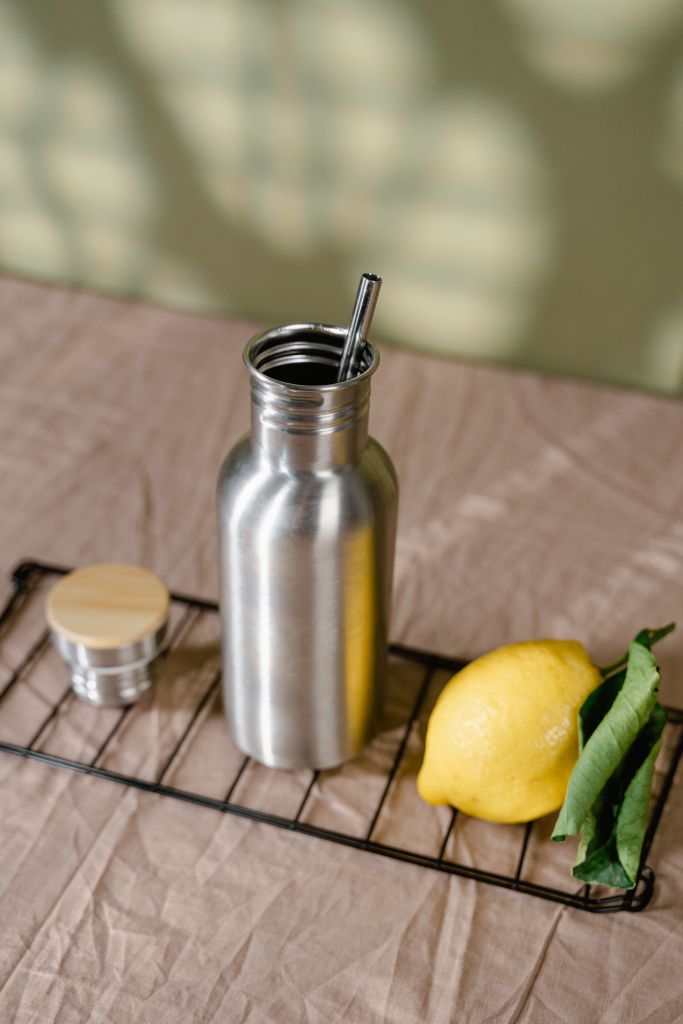
Rural Women and the Fight Against Single-Use Plastic in Local Markets

Why Local Markets Are a Plastic Hotspot

Weekly haats and local vegetable markets are where single-use plastic accumulates fastest — thin bags handed out per item, with no formal waste collection system to catch what’s left behind. In many villages, that plastic ends up burned, buried or washed into fields and water bodies.

Self-Help Groups Stepping In

Across several states, women’s self-help groups have taken on dual roles: producing cloth and jute bag alternatives for sale, and actively campaigning at local markets to get vendors and shoppers to switch away from plastic. The same groups that make biodegradable products for menstrual health or craft cooperatives are often behind these market-level plastic bans too — the skills and the SHG structure carry over.

What the Shift Actually Looks Like

  • Vendors stocking cloth or paper bags instead of plastic, often produced locally by SHG members
  • Leaf-plate and areca-leaf disposable ware replacing plastic plates at local food stalls
  • Market committees, sometimes nudged by SHGs, setting informal “no plastic bag” rules on market day
  • Awareness drives timed around local festivals and weekly market days, when plastic use spikes

The Economic Angle

This isn’t only environmental work — it’s income. Producing and selling cloth bags gives SHG members a product with steady local demand, since markets need bags every single week. That recurring demand is part of why these initiatives tend to stick, compared with one-off awareness campaigns.

What Still Gets in the Way

Cheap plastic remains easier and often slightly cheaper for vendors to access than cloth alternatives, and enforcement of any informal “ban” depends entirely on community buy-in rather than law.

Bottom Line

The fight against plastic in rural India isn’t happening through policy alone — it’s happening market day by market day, led by women’s groups who are both making the alternative and selling the idea.

The Rise of Eco-Friendly Period Products in Indian Villages

A Problem Hiding in Plain Sight

Disposable sanitary pads don’t biodegrade for decades, and in villages without formal waste management, they’re routinely burned or buried near homes. For years, the environmental cost of periods was rarely discussed alongside the more visible issue of period poverty — but the two problems share a solution.

Cloth Pads Are Having a Comeback

Reusable cloth pads, once dismissed as outdated, are being redesigned by women-led self-help groups and social enterprises with better absorbency, washable liners, and dignity-focused packaging. Several rural manufacturing units now train local women to stitch and sell these pads within their own communities, creating both income and access in one move.

Menstrual Cups Enter the Conversation

Menstrual cups are a newer addition to rural health workshops, though adoption is slower — it requires comfort with the body that many first-time users need guided support to build. NGOs running these workshops often pair the product demo with basic menstrual health education, since the two barriers (cost and stigma) rarely get addressed separately.

Why the Environmental Angle Matters Here

Framing reusable products purely as “eco-friendly” can miss the point in a village context — the bigger win is often affordability and reduced dependence on shops that may not stock pads reliably. The environmental benefit is real, but it works best as a bonus argument, not the opening one.

Bottom Line

The eco-friendly period movement in rural India isn’t a trend borrowed from urban sustainability circles — it’s a practical answer to cost, access, and waste, built by women for women.

E-Waste at Home: What Happens to Your Old Phones and Chargers

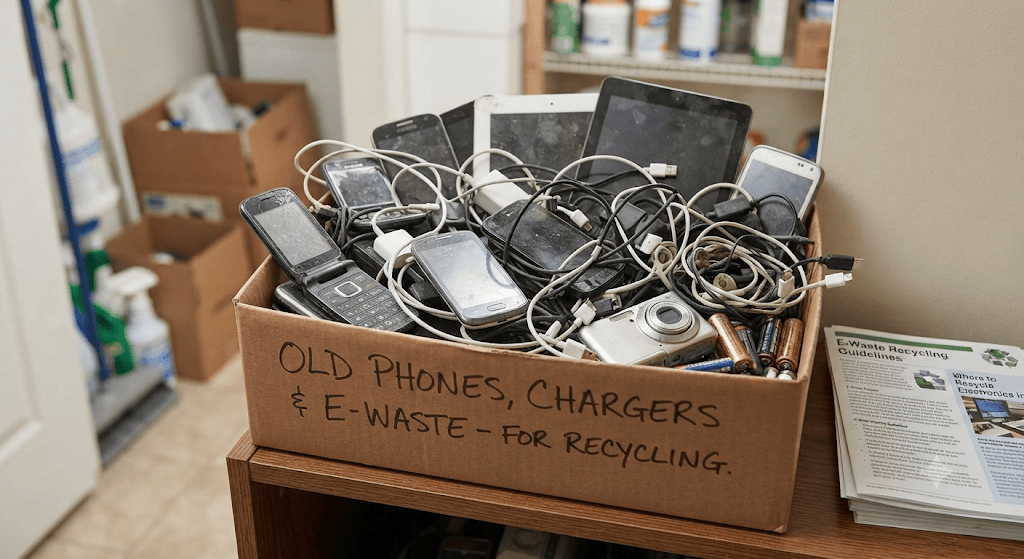
Almost every home has one — a drawer full of old phones, tangled chargers, and cables that no longer match any current device. It feels harmless sitting there, but e-waste is one of the fastest-growing and most under-addressed categories of household waste.

What Happens If It’s Thrown Away Normally

Electronics tossed into regular household trash typically end up in landfills, where components like batteries can leak heavy metals and toxic materials into soil and groundwater over time — a slow but genuinely damaging process that unfolds over years, largely unseen.

Why E-Waste Is Different From Other Trash

Unlike organic or paper waste, electronics don’t break down naturally, and many contain materials — lead, mercury, cadmium — that are hazardous when improperly disposed of, but also genuinely valuable and recoverable when processed correctly, including gold, copper, and other metals used in circuit boards.

The “Drawer Problem”

A huge share of e-waste never even reaches a landfill or a recycler — it just sits unused in homes indefinitely, which isn’t actively harmful, but also means genuinely reusable materials remain locked away instead of being responsibly recycled or the device being reused by someone else.

What Proper E-Waste Recycling Actually Does

Certified e-waste recyclers dismantle devices to separate hazardous components (which are safely processed) from valuable, reusable materials (which are extracted and reintroduced into manufacturing) — a genuinely more resource-efficient process than mining new raw materials from scratch.

Where to Actually Take It

  • Manufacturer take-back programs, which several phone and electronics brands now offer for old devices
  • Certified e-waste collection centers, increasingly available in most Indian cities
  • Retailer exchange or recycling programs, sometimes bundled with a discount on a new purchase
  • Local municipal e-waste drives, held periodically in many urban areas

Before You Recycle: Data Safety

Old phones and laptops often still contain personal data. A factory reset, and ideally removing SIM and memory cards, protects your information before handing a device off for recycling or resale.

Consider Reuse Before Recycling

A working but outdated phone, laptop, or charger may still have real value to someone else — donating functional electronics, or reselling them through a resale platform, extends their usable life before recycling becomes the more appropriate final step.

Bottom Line

That drawer of old electronics isn’t neutral — it’s either a missed recycling opportunity or, if eventually thrown out carelessly, a genuine environmental hazard. A single trip to a proper e-waste collection point turns years of accumulated clutter into responsibly processed material instead.

Urban Gardening: Growing Your Own Vegetables in a Small City Home

Growing your own vegetables sounds like something reserved for people with a farm or a sprawling backyard. In reality, a few pots, some sunlight, and a bit of consistency are enough to start — even in a compact city apartment.

Start With What Gets Sunlight

Most vegetables need at least 4-6 hours of direct sunlight. Before choosing what to grow, observe your balcony or window ledge across a day to see where light actually falls — this single factor determines more about your success than almost anything else.

Easiest Vegetables for Beginners

Leafy greens like spinach and fenugreek (methi), along with herbs like mint and coriander, grow quickly and forgive beginner mistakes more easily than fruiting vegetables like tomatoes or chillies, which need more consistent care and space.

Containers Don’t Need to Be Fancy

Grow bags, old buckets with drainage holes, or even repurposed plastic containers work just as well as expensive ceramic pots. What matters more is adequate depth for root growth and proper drainage to avoid waterlogging.

Get the Soil Mix Right

A simple mix of garden soil, compost, and coco peat (roughly equal parts) gives most vegetables enough nutrients and drainage to thrive in containers, where nutrients deplete faster than in open ground.

Water Consistently, Not Excessively

Overwatering is one of the most common mistakes in container gardening. Checking whether the top inch of soil is dry before watering again — rather than watering on a fixed daily schedule — prevents root rot and keeps plants healthier.

Compost What You Can

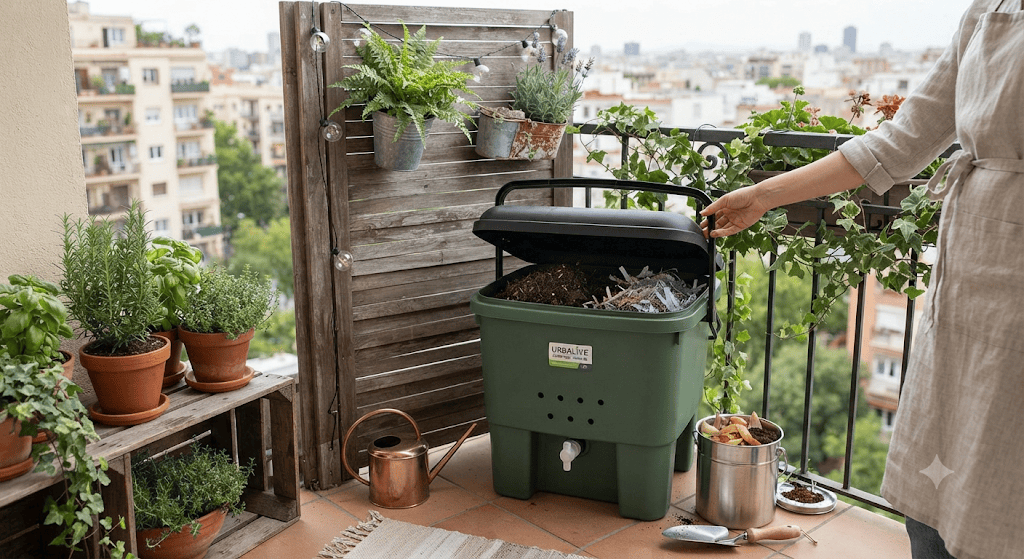
Kitchen scraps composted at home (even a small balcony setup) provide a steady, free nutrient source for your containers, closing the loop between your kitchen waste and your garden’s growth.

Manage Expectations

Urban gardening won’t replace your grocery shopping, and that’s fine — even a small harvest of fresh herbs or greens reduces some dependency on store-bought produce while giving a satisfying, hands-on connection to your food.

Bottom Line

A small city home doesn’t need to rule out growing your own food. A few well-chosen pots, some consistent care, and a little patience are often all it takes to turn an unused balcony corner into a small, functioning garden.

Composting for Beginners: A Simple Balcony Guide

Composting sounds like something that needs a big backyard or a rural setup — but it’s entirely doable on a city balcony, with nothing more than a small bin and some patience. Here’s a simple starting guide for anyone who wants to turn kitchen waste into something useful instead of trash.

Why Bother Composting on a Balcony

A large share of household waste is organic — vegetable peels, fruit scraps, tea leaves — and most of it ends up in landfills, where it breaks down slowly and releases methane. Composting it at home instead turns that same waste into nutrient-rich soil for your own plants, cutting down what you send out while feeding what you grow.

What You’ll Need

  • A compost bin or container with a lid — a simple plastic bucket, terracotta pot, or a stacked compost bin works fine
  • Some drainage holes drilled into the container if it doesn’t already have any
  • A base layer of dry material like dried leaves, newspaper, or coco peat
  • A small stick or trowel for turning and mixing

What You Can (and Can’t) Compost

Yes: vegetable and fruit peels, tea leaves, coffee grounds, eggshells, dry leaves, paper (non-glossy)

No: cooked food, oily or dairy items, meat, citrus peels in large quantities, diseased plant matter

Sticking to this list keeps the compost from smelling and prevents pest issues, which is the number one reason beginners give up early.

The Balance: Greens and Browns

Compost needs two types of material — “greens” (wet, nitrogen-rich scraps like vegetable peels) and “browns” (dry, carbon-rich material like dried leaves or shredded paper). A rough ratio of one part greens to two or three parts browns keeps the mix balanced, odor-free, and breaking down properly.

The Basic Routine

  1. Layer it — browns at the bottom, then alternate with greens as you add kitchen scraps
  2. Turn it every few days — mixing the pile with a stick or trowel adds air, which speeds up decomposition and prevents smell
  3. Keep it moist, not wet — it should feel like a damp sponge, not soaked
  4. Be patient — balcony composting typically takes 4 to 8 weeks to produce usable compost, depending on conditions

Signs It’s Working (or Not)

A healthy compost pile smells earthy, not rotten. If it smells bad, it usually means too many wet “greens” and not enough dry “browns” — add more dry material and turn it more often. If nothing seems to be breaking down, it may be too dry — add a little water and mix.

What to Do With Finished Compost

Once it looks dark, crumbly, and smells like soil rather than food waste, it’s ready. Mix it into potting soil for your balcony plants, or share it with a neighbor who gardens — either way, waste that would have gone to a landfill is now feeding something living.

Bottom Line

Balcony composting isn’t about doing it perfectly — it’s about doing it consistently. Even a small bin, tucked into a corner of an apartment balcony, can meaningfully cut down kitchen waste while giving your plants something landfill-bound scraps never could.

Small Daily Habits That Reduce Your Carbon Footprint

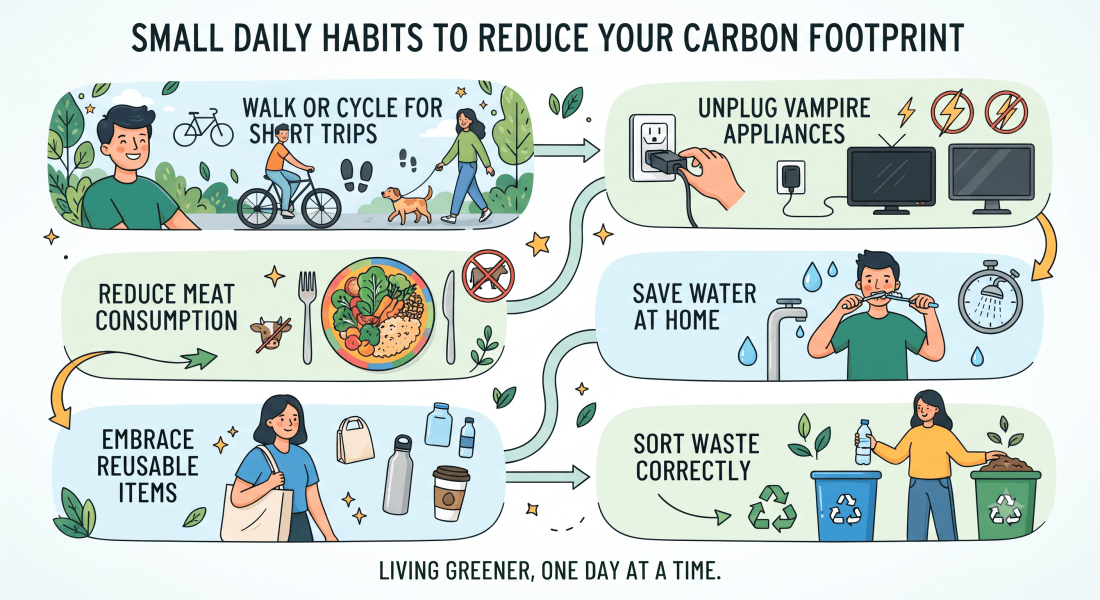
Cutting your carbon footprint doesn’t require a lifestyle overhaul. Most of the impact comes from small, repeatable habits — the kind that fit into an already busy day without feeling like a sacrifice.

Rethink Your Commute

Even swapping one or two car trips a week for walking, cycling, or public transport adds up over a year. If a full switch isn’t practical, carpooling with a colleague or neighbor cuts emissions per person without changing your route.

Unplug What You’re Not Using

Devices left plugged in — chargers, appliances, routers on standby — draw small amounts of power constantly. Unplugging them when not in use, or using a power strip you can switch off at once, is a near-zero-effort habit with a real cumulative effect.

Cut Down on Single-Use Plastic

Carrying a reusable water bottle, a cloth bag, or a steel tiffin instead of relying on single-use plastic each day reduces both your waste output and the emissions tied to producing that plastic in the first place.

Eat a Little More Local, a Little Less Processed

Food that travels shorter distances and requires less processing generally has a smaller carbon footprint. You don’t need to go fully local or vegetarian overnight — even shifting one or two meals a week toward local, less-processed options makes a difference over time.

Be Deliberate About Water Use

Shorter showers, turning off the tap while brushing your teeth or washing dishes, and fixing leaky taps promptly all reduce the energy used to heat, pump, and treat water — a footprint most people don’t think about day to day.

Buy Less, Use Longer

Fast fashion and short-lived gadgets both carry a heavy production footprint. Choosing quality over quantity, repairing instead of replacing, and reusing what you already have cuts down on manufacturing emissions far more than any single “eco” purchase can.

Bottom Line

None of these habits require a big budget or a dramatic lifestyle change. They’re small adjustments that, done consistently, add up to a meaningfully lighter footprint — proof that everyday choices matter just as much as big environmental policies.

Eco-Friendly Products I Actually Use Daily

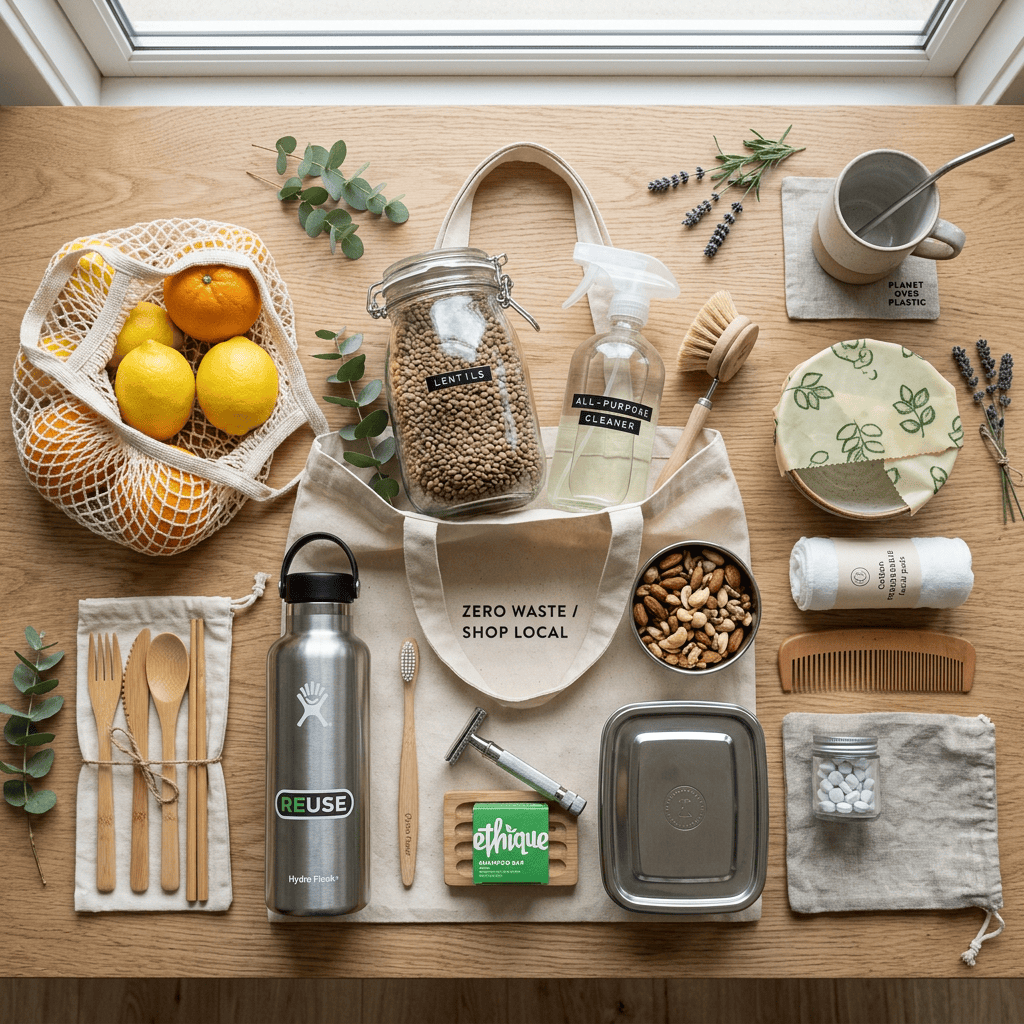
Zero waste items including reusable bag, stainless steel water bottle, wooden utensils, glass jar with lentils, natural cleaning spray, bamboo toothbrush, metal food container, shampoo bar, comb, and cotton rounds.

There’s a lot of noise around “zero waste” living that can feel overwhelming — bamboo everything, expensive swaps, an all-or-nothing pressure. What’s actually worked for me is much simpler: a handful of everyday products that quietly replaced their plastic-heavy counterparts, without needing a lifestyle overhaul.

1. Steel water bottle
The one swap that’s stuck the longest. No more buying plastic bottles when out, and it keeps water cool for hours.

2. Cloth pouches for groceries
Instead of taking a plastic bag for every small grocery run, a couple of cloth pouches folded into my bag handle most day-to-day shopping.

3. Bar shampoo
Skeptical at first, but a good bar shampoo lasts far longer than a bottle and skips the plastic packaging entirely. Bathroom shelf looks less cluttered too.

4. Reusable makeup remover pads
Replaced cotton pads completely — wash, reuse, repeat. Small change, but it adds up over months.

5. Steel lunch box
Swapped plastic containers for a steel one — keeps food fresher, and there’s no worry about plastic leaching into hot food.

None of these needed a “big” commitment — I added them one at a time, whenever the old version ran out or wore out. That’s usually the easiest way for a swap to actually stick, instead of trying to overhaul everything at once.

5 Simple Swaps to Reduce Plastic at Home

Plastic is everywhere in our daily lives — often without us even noticing. The good news is that reducing it doesn’t mean overhauling your entire home overnight. Small, consistent swaps add up over time. Here are five easy ones to start with:

1. Cloth bags instead of plastic bags
Keep a couple of cloth or jute bags near your front door or in your car. It sounds simple, but having them within reach is the difference between remembering and forgetting when you’re out shopping.

2. Steel or glass bottles instead of plastic ones
A good steel bottle lasts years and keeps water cooler for longer too. It pays for itself quickly compared to buying plastic bottles repeatedly.

3. Reusable containers instead of cling wrap
Steel or glass containers for storing leftovers not only cut down on plastic waste but also keep food fresher for longer.

4. Bar soap and shampoo bars instead of bottled versions
Bathroom plastic adds up fast — shampoo, conditioner, body wash bottles. Bar alternatives have gotten much better in quality recently and cut out a surprising amount of plastic.

5. Wooden or bamboo kitchen tools instead of plastic ones
Spatulas, spoons, chopping boards — small kitchen swaps that last long and don’t shed microplastics into your food over time.

None of these need to happen all at once. Pick one this week, get used to it, then move to the next. That’s usually how lasting habits actually stick.