Sustainable Souvenirs: What to Buy (and Avoid) While Traveling

Souvenir shopping feels like a harmless, even supportive part of travel — but not every souvenir actually benefits the place it comes from, and some genuinely work against it. A little awareness turns souvenir shopping into something that actually gives back.

What to Look For

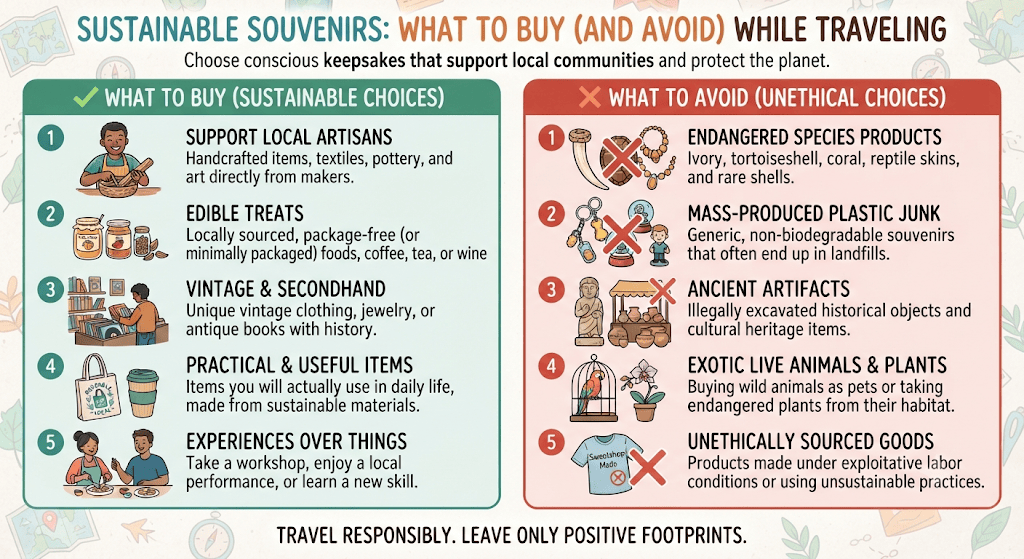
  • Handmade, locally produced items — textiles, pottery, woodwork — made by artisans in the region you’re visiting, rather than imported items simply sold there
  • Products from cooperatives or artisan collectives, which often ensure fairer pay reaches the actual makers rather than being absorbed by middlemen
  • Items made from sustainably sourced materials, particularly relevant for wood, shell, or plant-based products
  • Food items and spices sourced and packaged locally, which support regional agriculture directly

What to Avoid

  • Wildlife products — anything made from coral, ivory, animal skins, shells, or feathers, which often drives illegal poaching or environmental damage regardless of how it’s marketed
  • Mass-produced “local” items that are actually manufactured elsewhere and shipped in, offering no real benefit to the local economy despite the packaging
  • Ancient or archaeological artifacts, genuine or convincingly fake, which are frequently illegal to export and contribute to looting when authentic
  • Single-use or excessive packaging, which undercuts the sustainability of an otherwise reasonable purchase

Ask Before You Buy

A simple question to the seller — “who makes this, and where?” — often reveals a lot. Sellers proud of local, artisan-made goods are usually happy to share the story behind them; vague or evasive answers are often a signal the item isn’t what it’s marketed as.

Consider the Souvenir’s Actual Life After the Trip

A souvenir that ends up unused in a drawer within a year has the same environmental footprint as any other unnecessary purchase, regardless of how ethically it was sourced. Choosing something genuinely useful or meaningful — rather than buying for the sake of having bought something — reduces this kind of eventual waste.

Supporting the Economy Beyond Souvenirs

Buying meals, tours, and accommodations from local, small-scale businesses often has a bigger positive economic impact than souvenir shopping alone — souvenirs are one part of a broader pattern of how travel spending reaches (or bypasses) the local community.

Bottom Line

A souvenir can genuinely support a destination’s artisans and economy, or it can quietly contribute to exploitation, environmental harm, or a local economy that sees none of the benefit. A little curiosity about where an item actually comes from turns an ordinary purchase into a more meaningful one.

Women in Wildlife Photography: Patience, Risk, and the Perfect Frame

Wildlife photography has long carried an image of rugged, solitary men crouched in the bush for hours. That image is steadily being challenged by a growing number of women building genuine, respected careers in a field that demands patience, physical endurance, and a real tolerance for risk.

The Unglamorous Reality of the Work

Wildlife photography involves far more waiting than shooting — hours or even days positioned near a waterhole or den site, in extreme heat or cold, often with no guarantee that the anticipated shot will ever materialize. The romantic image of the “perfect frame” hides an enormous amount of unglamorous, physically demanding patience.

Facing Skepticism in the Field

Women wildlife photographers have often described being underestimated by local guides, forest staff, or even fellow photographers early in their careers — an assumption that physically demanding fieldwork wasn’t a natural fit for them, an attitude that’s shifted considerably but hasn’t disappeared entirely.

Building Technical Expertise From Scratch

Wildlife photography requires specific technical mastery — understanding animal behavior to predict movement, working with specialized long lenses, managing unpredictable lighting in the field — skills built over years of dedicated practice, same as any photographer regardless of gender, though often without as many visible mentors or role models to learn from directly.

The Physical and Safety Risks Involved

Working in proximity to wild animals, navigating remote terrain, and spending extended periods in isolated locations carries genuine physical risk — risk that doesn’t discriminate by gender, but that women in the field have sometimes had to actively push back against being told they shouldn’t take on.

Bringing a Different Perspective to the Work

Some women wildlife photographers have spoken about approaching their subjects with a particular sensitivity to behavior and storytelling — less focused purely on the dramatic “action shot,” and more interested in quieter, relationship-driven moments within animal groups, adding a distinct voice to a field often dominated by a narrower visual style.

Mentorship and Visibility Growing Slowly

As more women’s work gains recognition through awards, publications, and social media visibility, it’s gradually becoming easier for newer photographers to see a viable path into the field — role models that simply didn’t exist as visibly a generation ago.

Bottom Line

Wildlife photography rewards patience, technical skill, and a willingness to sit with real discomfort and risk for the sake of a single frame — qualities that have nothing to do with gender, but that women in the field have had to prove repeatedly regardless. Their growing presence is slowly reshaping who gets to be seen as an authority in this space.

E-Waste at Home: What Happens to Your Old Phones and Chargers

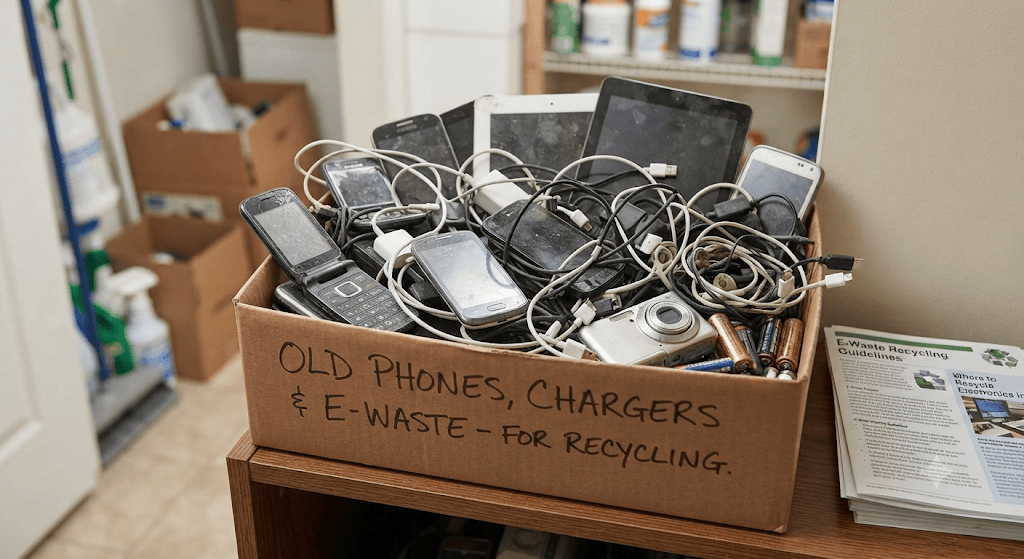
Almost every home has one — a drawer full of old phones, tangled chargers, and cables that no longer match any current device. It feels harmless sitting there, but e-waste is one of the fastest-growing and most under-addressed categories of household waste.

What Happens If It’s Thrown Away Normally

Electronics tossed into regular household trash typically end up in landfills, where components like batteries can leak heavy metals and toxic materials into soil and groundwater over time — a slow but genuinely damaging process that unfolds over years, largely unseen.

Why E-Waste Is Different From Other Trash

Unlike organic or paper waste, electronics don’t break down naturally, and many contain materials — lead, mercury, cadmium — that are hazardous when improperly disposed of, but also genuinely valuable and recoverable when processed correctly, including gold, copper, and other metals used in circuit boards.

The “Drawer Problem”

A huge share of e-waste never even reaches a landfill or a recycler — it just sits unused in homes indefinitely, which isn’t actively harmful, but also means genuinely reusable materials remain locked away instead of being responsibly recycled or the device being reused by someone else.

What Proper E-Waste Recycling Actually Does

Certified e-waste recyclers dismantle devices to separate hazardous components (which are safely processed) from valuable, reusable materials (which are extracted and reintroduced into manufacturing) — a genuinely more resource-efficient process than mining new raw materials from scratch.

Where to Actually Take It

  • Manufacturer take-back programs, which several phone and electronics brands now offer for old devices
  • Certified e-waste collection centers, increasingly available in most Indian cities
  • Retailer exchange or recycling programs, sometimes bundled with a discount on a new purchase
  • Local municipal e-waste drives, held periodically in many urban areas

Before You Recycle: Data Safety

Old phones and laptops often still contain personal data. A factory reset, and ideally removing SIM and memory cards, protects your information before handing a device off for recycling or resale.

Consider Reuse Before Recycling

A working but outdated phone, laptop, or charger may still have real value to someone else — donating functional electronics, or reselling them through a resale platform, extends their usable life before recycling becomes the more appropriate final step.

Bottom Line

That drawer of old electronics isn’t neutral — it’s either a missed recycling opportunity or, if eventually thrown out carelessly, a genuine environmental hazard. A single trip to a proper e-waste collection point turns years of accumulated clutter into responsibly processed material instead.

Rainwater Harvesting at Home: A Simple Guide for Renters and Owners

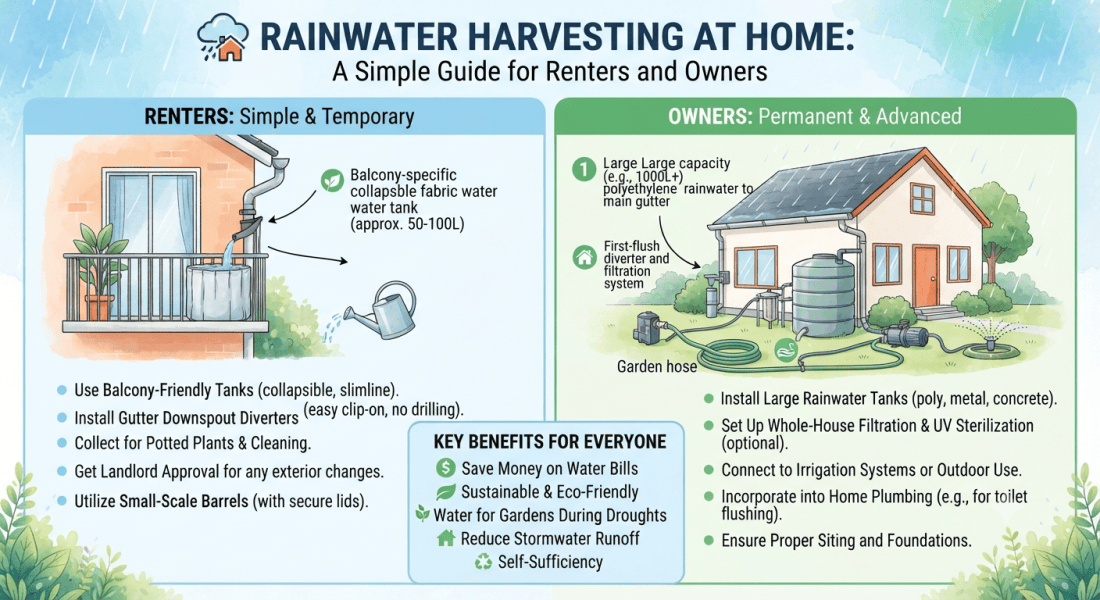
Rainwater harvesting sounds like a major home renovation project reserved for house owners with a big budget. In reality, there are options across a wide range of scale and investment — including simple setups that work even for renters in apartments.


Why It’s Worth Doing


Beyond reducing dependence on municipal or groundwater supply, rainwater harvesting helps recharge local groundwater tables and reduces stormwater runoff that would otherwise overwhelm drainage systems, especially in cities where over-extraction has caused water tables to drop significantly over the years.


For Renters: Small-Scale Options


Balcony collection barrels — a simple barrel or large container positioned to catch runoff from a balcony roof or overhang can supply water for plants, cleaning, or non-drinking household use
Diverting downspout water temporarily into a container during heavy rain, where structurally possible without permanent modification
Using harvested water for gardening specifically, which avoids the more complex filtration needed for potable use


For Homeowners: A More Complete System


Rooftop catchment — channeling roof runoff through gutters into a storage tank, ideally with a first-flush diverter to remove initial dirty runoff before storage
A basic filtration setup — mesh filters to remove debris, followed by sand or charcoal filtration for water intended for non-drinking uses like gardening or cleaning
A recharge pit or well, if space allows, to direct excess collected water back into the ground rather than letting it run off into street drainage


What Rainwater Should (and Shouldn’t) Be Used For


Without proper purification, harvested rainwater is best used for gardening, washing, or topping up non-potable needs — not drinking water, unless a more thorough filtration and treatment system is specifically installed and maintained for that purpose.


Basic Maintenance Matters


Even a simple barrel setup needs periodic cleaning to prevent mosquito breeding and algae buildup, and any filtration components need regular checking — a rainwater system that’s neglected can create more problems than it solves.


Government Incentives Worth Checking


Several Indian cities have introduced rainwater harvesting mandates or incentives for new constructions, and some municipal bodies offer subsidies or guidance for retrofitting existing homes — worth checking local regulations, since incentives and requirements vary significantly by city.


Bottom Line


Rainwater harvesting isn’t an all-or-nothing project — a renter with one balcony barrel and a homeowner with a full rooftop catchment system are both meaningfully contributing to the same larger goal. Starting small is a legitimate entry point, not a lesser version of “doing it properly.”

The Environmental Impact of Tourist Overcrowding in Hill Stations

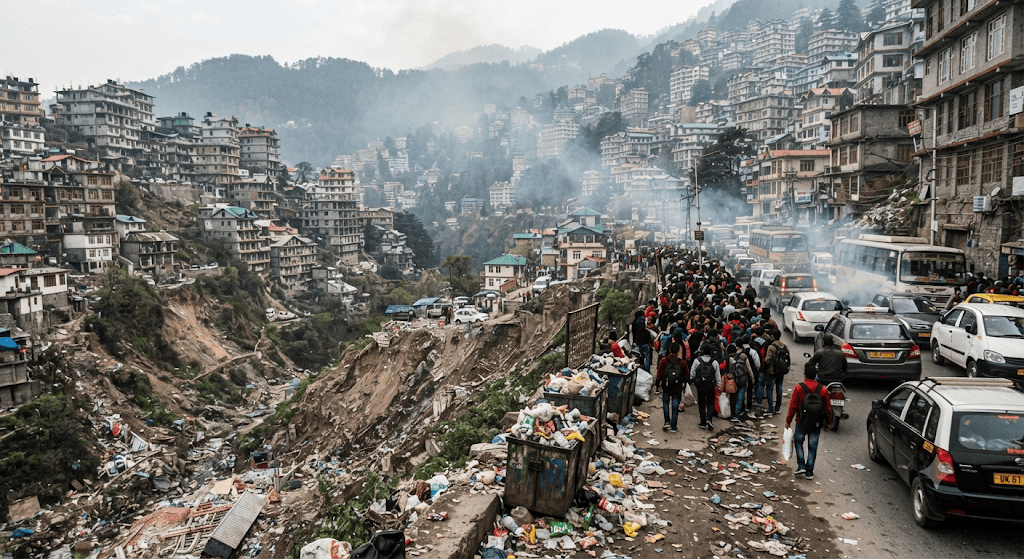
Every summer and long weekend, India’s popular hill stations see traffic jams stretching for kilometers, hotels overbooked well past reasonable capacity, and a strain on infrastructure never built for these numbers. The scenery that draws people there is quietly paying the price.

Water Systems Under Pressure

Many hill towns rely on limited natural water sources — springs, small reservoirs — that were never designed to support the seasonal population spikes tourism now brings. Water shortages during peak season have become a recurring issue in several well-known hill destinations, ironically driven by the very visitors drawn to their natural beauty.

Waste Management Falling Behind

Hill towns typically lack the large-scale waste processing infrastructure of bigger cities, and tourist season generates waste volumes far beyond what local systems can handle. This often results in visible littering, overflowing landfills at town edges, and waste finding its way into streams and forest areas.

Traffic and Air Quality

Long queues of idling vehicles on narrow hill roads, combined with unregulated parking on slopes never meant for heavy vehicle traffic, contribute to localized air pollution and slope stability concerns — a particularly serious issue in landslide-prone regions.

Construction Racing to Keep Up

Rising tourist demand has driven rapid, sometimes poorly regulated construction of new hotels and guesthouses, often on unstable slopes or encroaching on forest land — development that increases both environmental strain and genuine safety risk in these areas.

Impact on Local Wildlife and Vegetation

Increased foot traffic, off-trail wandering, and noise from a high volume of visitors disturbs local wildlife patterns and puts pressure on native vegetation, particularly in areas without clearly marked and enforced trail boundaries.

What More Sustainable Hill Station Travel Looks Like

  • Visit during shoulder seasons rather than peak weekends, spreading demand more evenly
  • Choose smaller, less-visited hill towns as alternatives to the most crowded, well-known destinations
  • Carry out your own waste, especially in areas without visible processing infrastructure
  • Support locally-run accommodations over large new constructions that add strain without local benefit
  • Stick to marked trails rather than off-path exploration that damages fragile vegetation

Bottom Line

The hill stations most affected by overcrowding are often loved precisely for qualities that overcrowding itself is steadily eroding. A more spread-out, mindful approach to visiting these places isn’t about avoiding them — it’s about making sure they’re still worth visiting years from now.

Thrifting and Upcycling: A Beginner’s Guide to Second-Hand Fashion

Thrifting has a learning curve that puts a lot of first-timers off after one overwhelming visit. But once you know what to look for, second-hand shopping becomes less of a gamble and more of a genuinely useful skill — for your wardrobe and for the environment.

Why Thrifting Is Worth Learning

Buying second-hand extends the life of garments that would otherwise be discarded, reducing the demand that drives fast fashion’s resource-heavy production cycle. It’s also often significantly cheaper than buying new, especially for well-made pieces that have simply gone out of a previous owner’s rotation.

Where to Start Looking

Local thrift and second-hand stores, online resale marketplaces, and even neighborhood clothing exchange groups are all reasonable starting points. Online platforms are often easier for beginners since you can search by size and category, rather than digging through a physical rack blind.

What to Check Before Buying

  • Fabric quality — natural fibers tend to hold up better over time than cheap synthetics, even second-hand
  • Seams and stitching — check for loose threads or stress points that suggest the garment won’t last much longer
  • Fit potential — a slightly oversized piece is often more alterable than one that’s too tight
  • Stains and odors — some are treatable, others aren’t; a quick honest check saves disappointment later

Don’t Expect to Find Everything at Once

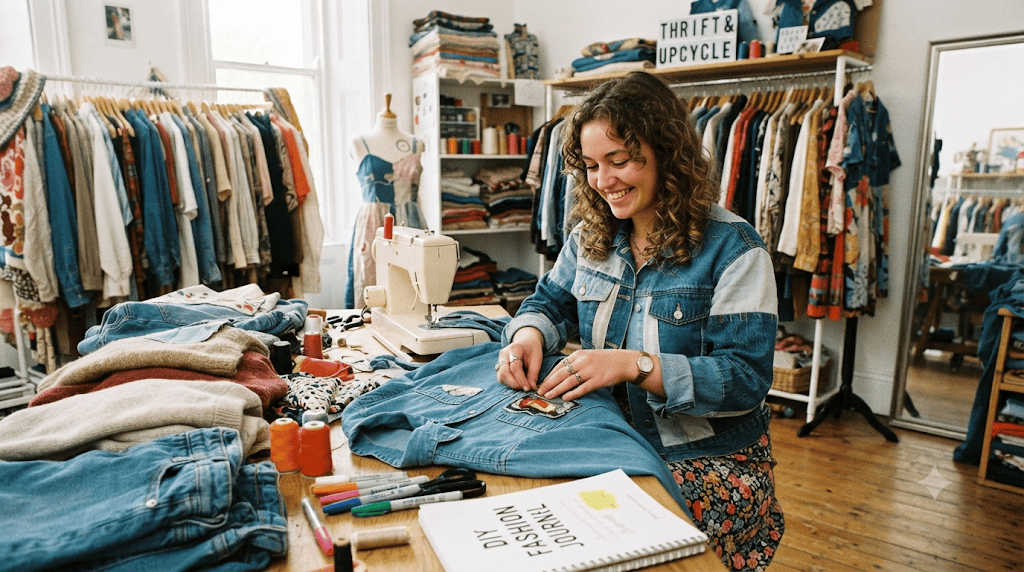
Thrifting isn’t like shopping with a specific item in mind — inventory is unpredictable. Going in with a loose idea (“a denim jacket, something in blue”) rather than an exact requirement makes the process far less frustrating for beginners.

Basic Upcycling Ideas to Try

  • Cropping or hemming an oversized piece to fit better
  • Dyeing faded garments to refresh the color
  • Patchwork repairs on small tears, turned into a visible design choice rather than hidden
  • Repurposing fabric from unwearable garments into bags, cushion covers, or other household items

Building the Habit Gradually

Thrifting rewards patience more than urgency — treating it as an occasional, low-pressure activity rather than a one-time shopping trip with a strict list tends to produce better finds and a more enjoyable experience overall.

Bottom Line

Thrifting and upcycling aren’t about giving up on personal style — they’re about building it more sustainably, one intentional find at a time. The learning curve flattens quickly once you know what to check for and stop expecting every trip to be a perfect match.

Period Poverty in India: What’s Actually Being Done About It

If you’ve ever had to ask a stranger for a pad, skip school because you didn’t have access to menstrual products, or use a rag, sand, ash, or newspaper during your period — you already know what period poverty feels like. For millions of women and girls across India, this isn’t a hypothetical. It’s a monthly reality.

Period poverty isn’t just about not being able to afford a pack of sanitary pads. It’s a tangle of three things: lack of access to safe menstrual products, lack of access to clean water and private toilets to manage periods hygienically, and — maybe the most stubborn of all — the silence and shame that stops girls from asking for help in the first place.

The Scale of the Problem

Government surveys have repeatedly shown that a large share of menstruating women in India still don’t use hygienic methods of protection, especially in rural areas. The gap isn’t uniform either — it varies sharply by state, by income, and by whether a girl is still in school. Many girls drop out of school entirely once they start menstruating, not because they want to, but because their school has no functioning toilet, no privacy, and no way to manage a leak with dignity.

This isn’t a “women’s issue” tucked away in a corner. It affects education outcomes, workforce participation, and public health — which is exactly why it deserves more attention than it gets.

What’s Actually Being Done

The good news is that period poverty in India isn’t being ignored anymore. Here’s where real movement is happening:

1. GST removal on sanitary products. In 2018, after sustained public pressure and activism, India removed the 12% GST that had been levied on sanitary napkins. It was a small line item that made a real difference in affordability at scale.

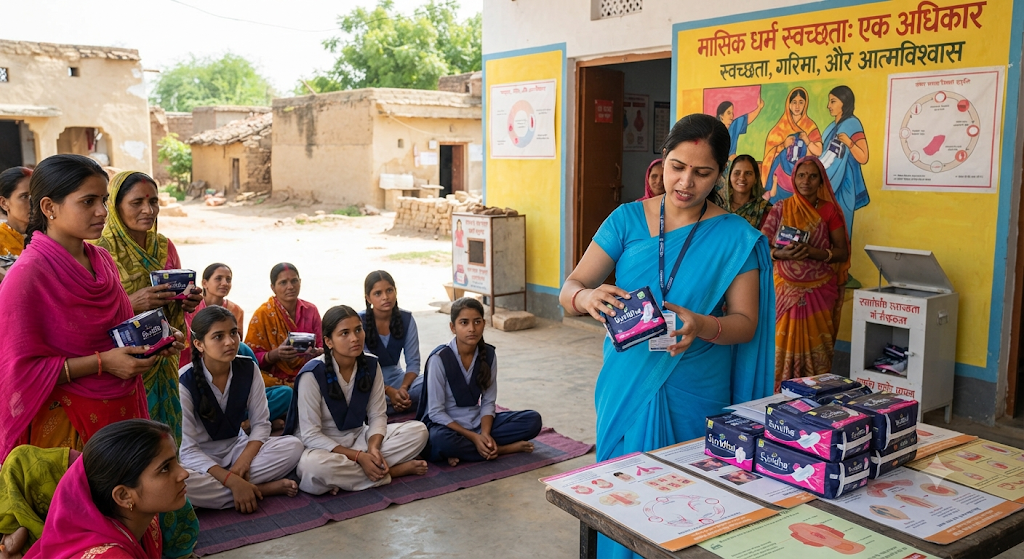
2. Government distribution schemes. Programs at both the central and state level have worked to supply subsidized or free sanitary pads through schools and primary health centres, particularly targeting rural and adolescent girls. Coverage is uneven, but the intent — and the infrastructure — now exists in places it didn’t before.

3. Menstrual health in the school curriculum. Several states have started integrating menstrual hygiene education into school health programs, training teachers and health workers to talk about periods without euphemism or embarrassment, and installing incinerators and sanitary vending machines in government schools.

4. NGOs closing the last-mile gap. Organizations working at the grassroots level — going village to village, training local women as menstrual health educators, manufacturing low-cost sanitary pads through community-run micro-enterprises — have often reached places that policy alone hasn’t. Some of the most effective models pair product distribution with education, because handing someone a pad without addressing the stigma around periods only solves half the problem.

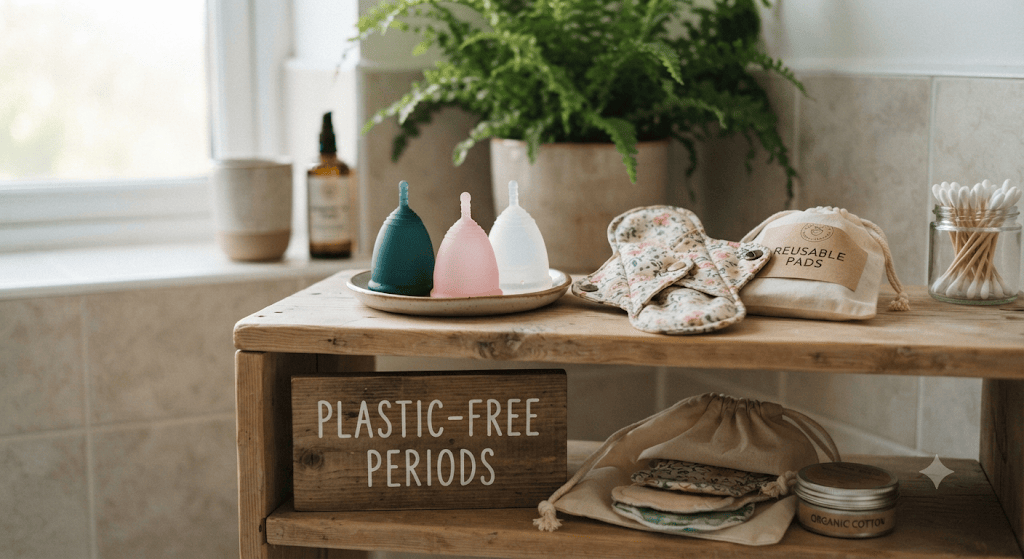
5. Sustainable and reusable alternatives. Menstrual cups, cloth pads, and period underwear are getting more visibility, both as a cost-saving option for low-income households and as a lower-waste alternative to disposable pads, which are a genuinely enormous environmental burden — most contain plastic and take centuries to break down.

Where the Gaps Still Are

For all this progress, period poverty hasn’t been solved — not close. Distribution schemes don’t always reach the most remote areas. Products supplied by some programs are inconsistent in quality. And the biggest gap of all is cultural: even where products are available, shame and silence still keep many girls from using them confidently, or from talking to a parent, teacher, or doctor when something feels wrong.

Access without education is a half-measure. A girl who has a pad but has never been told what a period actually is, why it happens, or that it’s nothing to be ashamed of, is still navigating this mostly alone.

What You Can Actually Do

You don’t need to run an NGO to make a dent in this. A few starting points:

  • Support grassroots organizations directly working on menstrual health in your city or state — many are chronically under-resourced and rely on small, recurring donations more than one-time large ones.
  • Normalize the conversation at home. If you have younger sisters, cousins, or nieces, be the person who talks about periods like it’s just biology — because it is.
  • Donate products, not just money, during pad drives, especially before monsoon season and before the school year starts, when supply often runs low.
  • Choose sustainable products where you can, and talk about them openly — cups and reusable pads are still seen as niche in a lot of households, and visibility helps.

Period poverty sits at the intersection of everything this blog cares about — women’s dignity, environmental impact, and access to basic health infrastructure. It’s a solvable problem. It just needs more people treating it like the public health issue it actually is, instead of a private embarrassment to whisper about.

The Hidden Environmental Cost of Fast Fashion Hauls

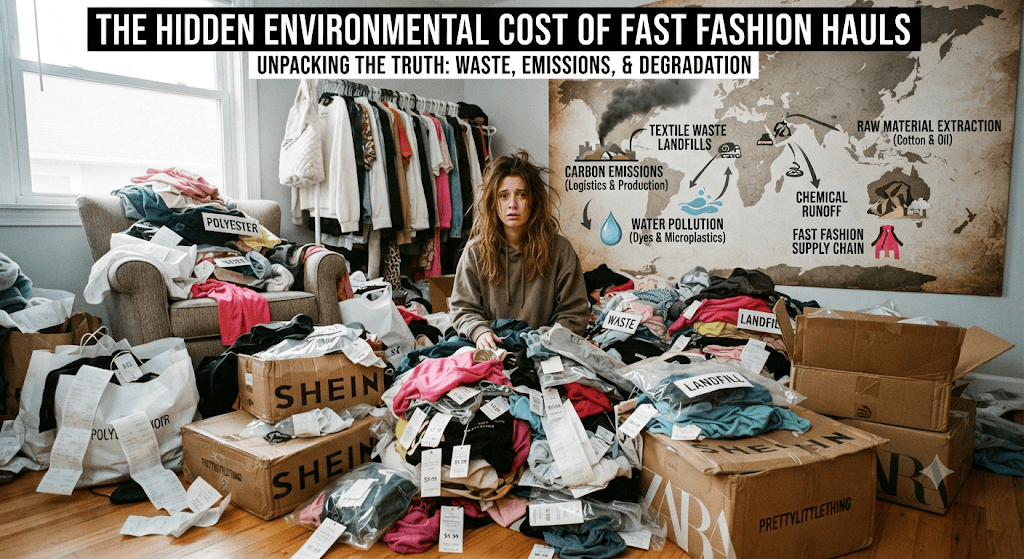
A ₹300 top that’s trendy for one season and forgotten the next feels harmless in isolation. Multiplied across millions of similar purchases, though, fast fashion carries an environmental cost that rarely shows up on the price tag.

The Resource Cost Before It Even Reaches You

Producing a single garment involves significant water and energy use — particularly for cotton cultivation and dyeing processes — well before it ever reaches a store shelf. Fast fashion’s business model depends on producing at massive volume and speed, multiplying this resource cost across an enormous number of garments made to be worn only briefly.

The Waste Problem After You’re Done

Garments designed for short-term trend cycles are often made from cheaper, lower-quality materials that don’t hold up to repeated wear or resale. Much of this clothing ends up discarded within a year or two, contributing to a fast-growing volume of textile waste, most of which isn’t recycled and ends up in landfills.

Synthetic Fabrics and Microplastics

A large share of fast fashion is made from synthetic fibers like polyester, which shed microplastic fibers with every wash — fibers that eventually make their way into waterways and, ultimately, the food chain. This is a slower, less visible cost, but a real one.

The “Haul Culture” Problem

Social media content built around hauls and constant new outfits normalizes a pace of consumption that has little to do with actual need. It reframes buying and quickly discarding clothing as entertainment, which quietly increases demand for the fastest, cheapest production cycles.

What a Lighter Approach Looks Like

  • Buy fewer, better pieces that are likely to be worn repeatedly, not just once for content
  • Check fabric composition and lean toward natural fibers where possible, which tend to last longer and shed less
  • Repair before replacing — a small tear or loose button doesn’t always mean a garment is done
  • Resell or donate rather than discard, extending a garment’s life beyond your own closet

Bottom Line

Fast fashion’s low price hides a cost that shows up elsewhere — in water use, textile waste, and microplastic pollution that isn’t part of the transaction at checkout. None of this means giving up new clothes entirely; it just means being a little more deliberate about how often, and how much, gets bought and discarded.

Women Rangers and Forest Guards Protecting India’s Wildlife

Forest protection has long been seen as a man’s domain in India — long patrols, physical risk, remote postings. But across the country’s reserves, thousands of women are now doing exactly this work, often in some of India’s most challenging terrain.

Gir National Park: The Lionesses of Gujarat

<cite index=”1-1″>Gujarat’s Gir Forest appointed its first batch of 51 women forest guards in 2007</cite>. These women patrol vast stretches of forest protecting the world’s only wild population of Asiatic lions, regularly handling wildlife rescues — from injured lion cubs to venomous snakes — as part of routine duty rather than exceptional heroics.

Kaziranga’s “Van Durgas,” Assam

<cite index=”3-1″>At Kaziranga National Park, female forest guards known locally as “Van Durgas” come from rural communities and work to protect wildlife and habitat across the park’s roughly 430 square kilometers</cite>. <cite index=”4-1″>The park now includes around 40 female rangers across roles like Range Officers, Forest Guards, and Foresters</cite>, alongside a dedicated women’s unit within the Special Rhino Protection Force guarding the endangered greater one-horned rhinoceros from poaching.

Dudhwa Tiger Reserve, Uttar Pradesh

<cite index=”6-1″>Dudhwa Tiger Reserve has recruited young men and women as forest watchers</cite>, with officials describing it as a pioneering effort to bring women into forest protection roles that had rarely included them before.

Gurukula Botanical Sanctuary, Western Ghats

<cite index=”7-1″>In Kerala’s Western Ghats, an all-female team of 27 women serves as guardians of the region’s rare and threatened plant species</cite>, working to protect biodiversity in one of the world’s most ecologically significant and endangered mountain ranges.

Why This Shift Matters

Beyond conservation outcomes, women forest guards often bring specific advantages — better rapport with village women during community conflict resolution, and a visible signal to younger women in these regions that this kind of work is possible for them too. Several of the women in these programs have spoken about how their entry inspired others locally to apply.

The Work Isn’t Symbolic

These aren’t ceremonial postings. Women forest guards conduct real patrols, handle wildlife emergencies, and in some cases carry weapons as part of anti-poaching units — work that comes with genuine physical risk and long stretches away from family, often in remote, difficult terrain.

Bottom Line

India’s forests are being protected, in real and growing numbers, by women who chose this work deliberately — not as an exception, but as a profession. Their presence is reshaping who gets to be seen as a protector of India’s wildlife, one patrol at a time.

Plastic-Free Periods: Are Reusable Products Actually Worth It?

Reusable menstrual products get recommended constantly for their environmental benefits, but the practical side of actually switching — comfort, cost, hygiene, learning curve — gets far less honest discussion. Here’s a grounded look at what the switch actually involves.

The Waste Problem With Disposables

A single person using disposable pads or tampons generates a significant amount of non-biodegradable waste over their menstruating years — most of it made from plastic that will outlast the person who used it by centuries. This is the core environmental argument for reusables, and it’s a real one.

Menstrual Cups: The Learning Curve Is Real

Menstrual cups have the steepest initial learning curve of any reusable option — folding, insertion, and removal take a few cycles to get comfortable with. Most people who stick with it past the first two or three cycles report it becoming easy, but the early frustration is genuine and shouldn’t be dismissed.

Reusable Cloth Pads: The Gentler Switch

Cloth pads function almost identically to disposable pads, just washed and reused, making them a much easier first step into reusable products without requiring any new technique to learn. The tradeoff is needing proper washing facilities and a bit more laundry.

The Cost Math Over Time

Reusable products cost significantly more upfront — a good menstrual cup or a set of cloth pads can cost as much as several months of disposables. But since they last years, not months, the long-term cost is substantially lower, often paying for itself within a year or so of consistent use.

Hygiene Considerations

Reusable products require proper cleaning — boiling cups between cycles, thoroughly washing cloth pads — which takes more active effort than simply disposing of a used product. For people without reliable private washing access, this is a genuine practical barrier, not a minor inconvenience.

They’re Not All-or-Nothing

Many people who switch don’t go 100% reusable — using cups or cloth pads at home and disposables while traveling or in situations with limited hygiene facilities is a common, practical middle ground rather than an everything-or-nothing choice.

Bottom Line

Reusable menstrual products genuinely reduce waste and save money over time, but they come with real upfront cost, a learning curve, and hygiene logistics that aren’t right for every situation. They’re worth trying, but not something to feel obligated to switch to completely — a partial switch still meaningfully reduces waste compared to full reliance on disposables.